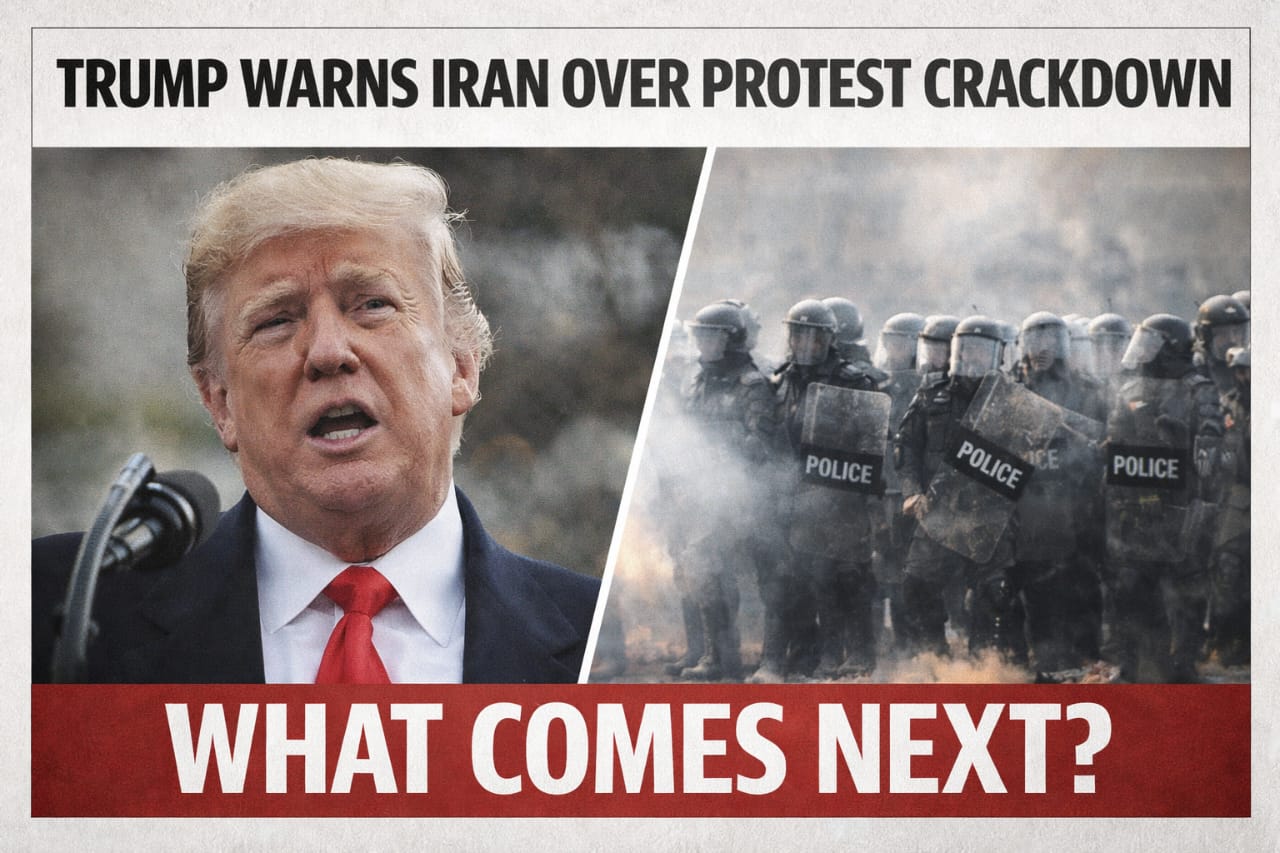
Trump Warns Iran Over Protest Crackdown: What Comes Next?
Trump warns Iran has emerged as one of the most searched geopolitical phrases after U.S. President Donald Trump issued a blunt warning to Tehran amid growing protests across the Islamic Republic. The unrest, triggered by soaring inflation and a sharp fall in the value of Iran’s currency, has already resulted in several deaths and dozens of arrests, according to official and rights group reports.
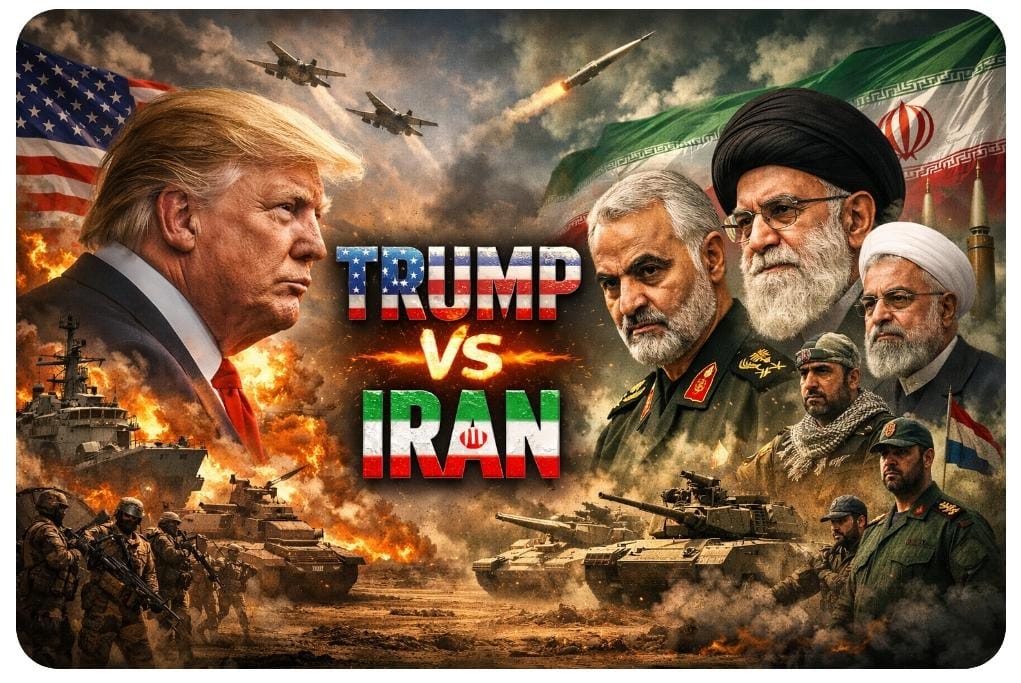
Trump’s declaration that the United States is “locked and loaded” if Iranian security forces fire on protesters has raised urgent questions: Is this rhetoric, deterrence, or a signal of possible intervention?
What Did Trump Say? Key Statements Explained
Trump Warns Iran Over Protest Crackdown –
Speaking on social media, Trump warned that any violent response by Iranian authorities against demonstrators would draw a U.S. response. While he did not specify what form that response might take, the warning marked one of the strongest statements by a U.S. president linking Iran’s internal unrest to potential external consequences.
The comments come months after U.S. and Israeli airstrikes targeted Iranian nuclear facilities and military assets, further tightening pressure on Tehran.
Trump’s Warning in Simple Terms –
When Trump warned Iran, his message focused on one red line:
violence against peaceful protesters.
Key points from Trump’s statement:
- The U.S. is prepared to act if protesters are killed
- America will “come to their rescue” if violence escalates
- No specific military action was outlined
- Ground troops were explicitly ruled out
This language mirrors Trump’s earlier “maximum pressure” doctrine but adds a sharper, more personal tone aimed directly at Iran’s leadership.
Why Are Protests Erupting in Iran Now?
Economic Crisis at the Core –
Iran’s current unrest is primarily economic, not ideological.
Main Triggers:
- Sharp fall in the Iranian rial
- Inflation exceeding 36%
- Rising food and fuel prices
- Job losses and declining purchasing power
The protests began in Tehran and quickly spread to western and southern provinces, including regions dominated by Kurdish and Baluch minorities.
Timeline of Events: From Currency Collapse to Trump’s Warning
| Date | Event |
|---|---|
| Late Dec 2025 | Iranian rial plunges on unofficial markets |
| Jan 1, 2026 | Protests begin in Tehran markets |
| Jan 2, 2026 | Protests spread nationwide |
| Jan 2, 2026 | Reports of deaths and arrests |
| Jan 2, 2026 | Trump warns Iran publicly |
Casualties, Arrests, and Security Response:
What We Know So Far –
- At least 6 confirmed deaths
- Dozens arrested across western Iran
- Reports of gunfire and burning police buildings
- State media acknowledges limited fatalities
- Rights groups report broader repression
Iranian officials have warned that illegal gatherings will be met “decisively and without leniency.”
Iran’s Response: Rejection and Counter-Warnings
Official Iranian Position –
Senior Iranian officials rejected Trump’s comments outright.
Key reactions include:
- Claims of foreign interference
- Warnings that U.S. involvement would destabilize the region
- Threats directed at U.S. forces in the Middle East
Iran’s leadership framed Trump’s warning as an attempt to exploit domestic unrest rather than protect human rights.
Role of Iran’s President: A Softer Tone from the Top?
President Masoud Pezeshkian’s Approach –
Unlike hardline clerics, Iran’s president adopted a conciliatory stance.
Notable remarks:
- Acknowledged government failures
- Accepted blame for economic mismanagement
- Promised dialogue with protest leaders
However, this softer rhetoric contrasts sharply with actions taken by security forces on the ground.
Trump Warns Iran: Strategic Motives Behind the Statement
Why Trump Spoke Now ?
Trump’s warning did not emerge in isolation.
Strategic Context:
- Recent U.S.–Israeli strikes on Iranian nuclear sites
- Collapse of Iran’s regional allies
- Ongoing sanctions pressure
- Trump’s meeting with Israeli leadership
The message serves multiple purposes:
- Deterrence against mass violence
- Reassurance to allies
- Domestic political signaling
- Pressure on Iran’s ruling elite
Comparison: How This Crisis Differs from Past Iranian Protests
Trump Warns Iran vs 2022 Protests –
| Factor | 2022 Protests | 2026 Protests |
|---|---|---|
| Trigger | Custodial death | Economic collapse |
| Scale | Nationwide, sustained | Growing but uneven |
| Death toll | Hundreds | Dozens (so far) |
| US response | Diplomatic pressure | Direct presidential warning |
| Iran’s economy | Strained | Near crisis |
This makes the current unrest potentially more dangerous, as economic pain affects a broader population.
Graph Insight: Iran’s Economic Decline (Suggested CMS Graph)
Graph Title: Iranian Rial vs Inflation (2022–2026)
Description:
- Line 1: Rial value declining sharply post-2024
- Line 2: Inflation rising steadily above 30%
- Key marker: Protest outbreaks aligned with currency drops
This visual reinforces the direct link between economics and unrest.
Regional Implications: Why the Middle East Is on Edge ?
Possible Spillover Effects –
If Trump’s warning escalates:
- Proxy groups in Iraq, Lebanon, and Yemen may react
- Shipping routes in the Gulf face higher risk
- Oil prices could spike
- Regional security forces may be mobilized
Iran’s network of allied groups gives it leverage — but also vulnerability.
US Policy Options After Trump Warns Iran:
What the US Could Do (and What It Likely Won’t) ?
| Option | Likelihood | Impact |
|---|---|---|
| Diplomatic sanctions | High | Moderate |
| Cyber operations | Medium | High |
| Targeted airstrikes | Low–Medium | Severe |
| Ground invasion | Very low | Extreme |
Trump’s history suggests preference for pressure without prolonged war.
International Reaction: Global Powers Watching Closely
- Europe urges restraint
- Russia and China call for non-interference
- Israel supports firm US posture
- Gulf states quietly monitor escalation risks
The world is watching how Iran responds internally — not just what the US does externally.
Public Sentiment Inside Iran:
Protester Demands Go Beyond Economics –
While inflation sparked the protests, chants and slogans show deeper frustration:
- Anger at corruption
- Rejection of elite privilege
- Calls for accountability
This raises concerns for Iranian authorities, as economic protests often evolve into political ones.
Frequently Asked Questions (FAQ):
Q1: Why did Trump warn Iran now?
Trump responded to reports of deadly crackdowns during widespread economic protests, aiming to deter further violence.
Q2: Is the US planning military action against Iran?
No specific action has been announced. Trump ruled out ground troops but did not exclude other measures.
Q3: Are these protests bigger than past unrest?
They are the largest since 2022 but currently less sustained. However, economic conditions are worse now.
Q4: How is Iran’s government reacting internally?
Security forces are cracking down, while the president has promised dialogue.
Q5: Could this lead to a wider war?
If proxy forces become involved or violence escalates significantly, regional conflict risks increase.
What Happens Next After Trump Warns Iran?
The warning from Trump marks a turning point. It signals that Iran’s internal crisis has crossed into international consequence. Whether this leads to restraint or escalation depends on one critical factor:
How Iran’s security forces respond to protesters in the coming days.
If violence intensifies, diplomatic pressure may quickly turn into something more severe. If restraint prevails, this moment may pass — but the economic forces driving unrest will remain.
Why India’s Top Industrialist Took the Hot Seat ?
About the Author