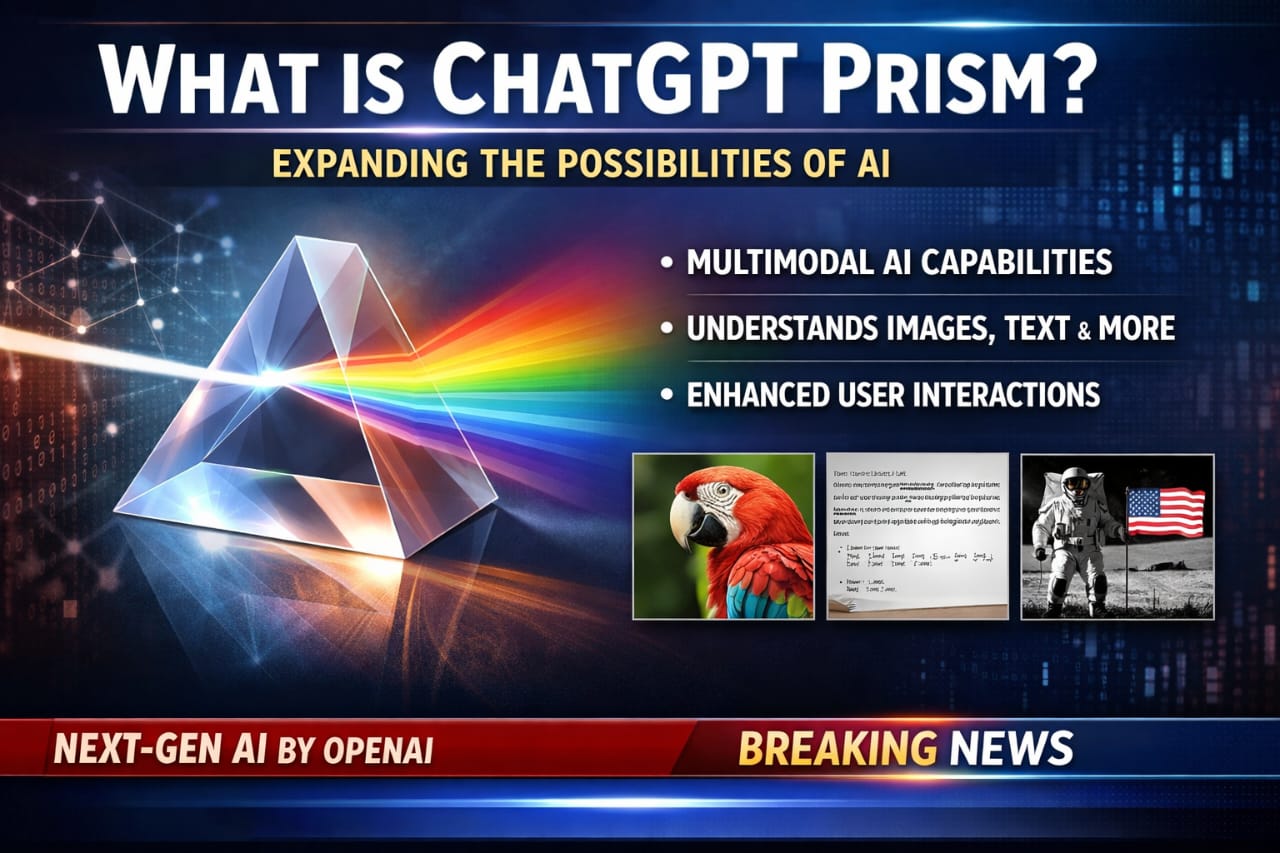
What Is ChatGPT Prism & How It Transforms Scientific Writing
Scientific research has always depended on collaboration, precision, and time-intensive workflows. From drafting manuscripts and formatting equations to managing citations and coordinating with co-authors, researchers often juggle fragmented tools that slow down discovery.
In January 2026, OpenAI changed that equation.
With the launch of OpenAI’s latest product Prism, the company introduced a free, AI-native workspace designed specifically for scientific writing and collaboration. Powered by GPT-5.2, Prism embeds advanced reasoning directly into the research workflow, promising faster writing, deeper insights, and smoother teamwork.
This article explores what is ChatGPT Prism, how it works, how it compares to existing tools, and why it could quietly reshape how science gets written.
Table of Contents:
What Is ChatGPT Prism?
What is ChatGPT Prism?
At its core, Prism is a cloud-based scientific writing and collaboration platform that integrates ChatGPT directly into a document editor.
Unlike generic AI writing tools, Prism is purpose-built for researchers. It supports LaTeX, equations, citations, diagrams, hypothesis testing, and real-time collaboration — all in one workspace.
Key Definition –
ChatGPT Prism is an AI-powered research editor that helps scientists draft, revise, reason, collaborate, and manage literature using GPT-5.2 inside a single unified interface.
Prism is free to use for anyone with a personal ChatGPT account, with no limits on projects or collaborators.
Why OpenAI Built Prism for Scientists?
OpenAI revealed that more than 1.3 million scientists already use ChatGPT regularly, submitting millions of advanced queries every week. This behavior signaled a shift: AI was no longer a novelty for researchers — it had become part of their daily workflow.
Problems Prism Aims to Solve –
| Research Pain Point | Traditional Approach | Prism’s Solution |
|---|---|---|
| Fragmented tools | Word + LaTeX + citation managers | Unified workspace |
| Manual formatting | Time-consuming | AI-assisted LaTeX |
| Literature overload | Manual reading | AI summarization |
| Collaboration delays | Email chains | Real-time editing |
| Reasoning bottlenecks | Solo effort | GPT-5.2 reasoning |
OpenAI’s latest product Prism is designed not to replace scientists, but to remove friction from the scientific process.
PlayStation Plus Free Games February 2026:
Core Features of OpenAI’s Latest Product Prism:
1. AI-Assisted Scientific Writing
Prism can draft and revise papers with full context, including:
- Equations
- Figures
- References
- Section-level structure
2. Advanced Reasoning with GPT-5.2
Researchers can:
- Explore hypotheses
- Debug mathematical proofs
- Test assumptions
- Catch logical inconsistencies
3. Literature Search & Citation Management
Prism can search relevant research and integrate citations directly into the manuscript, reducing context switching.
4. Equation, Diagram, and LaTeX Support
- Converts whiteboard sketches into LaTeX
- Supports mathematical notation natively
- Handles complex diagrams
5. Real-Time Collaboration
Unlimited co-authors, students, and advisors can work simultaneously.
6. Voice-Based Editing
Dictate changes, brainstorm ideas, or revise text using voice commands.
How Prism Transforms Scientific Writing?
Traditional Workflow vs Prism Workflow –
Traditional Research Writing
----------------------------
Idea → Notes → Draft → Revise → Cite → Format → Share → Revise Again

Prism Workflow
--------------
Idea → AI-Assisted Draft + Reasoning + Citations + Collaboration (Continuous)
Productivity Impact (Illustrative Graph) –
Research Time Allocation (%)

Task               Traditional   Prism
---------------------------------------
Writing               35%         20%
Formatting            20%          5%
Literature Review     25%         15%
Collaboration         10%          5%
Actual Research       10%         55%
By automating overhead tasks, OpenAI’s latest product Prism allows researchers to spend more time on actual discovery.
Prism vs Traditional Research Writing Tools:
| Feature | Word / LaTeX Editors | Prism |
|---|---|---|
| Built-in AI reasoning | ❌ | ✅ |
| Literature integration | ❌ | ✅ |
| Equation intelligence | Limited | Advanced |
| Collaboration | Partial | Real-time |
| Hypothesis testing | ❌ | ✅ |
| Cost | Paid software | Free |
Prism doesn’t just improve writing — it reshapes the thinking process around it.
Prism vs Other AI Writing Platforms:
| Platform | Focus | Scientific Depth | Collaboration |
|---|---|---|---|
| Generic AI writers | Marketing / blogs | Low | Limited |
| AI coding editors | Software | Medium | Medium |
| Office AI tools | Productivity | Medium | Medium |
| ChatGPT Prism | Science & research | High | Unlimited |
Unlike general tools, what is ChatGPT Prism answers a very specific need: scientific rigor combined with AI reasoning.
Real-World Use Cases Across Disciplines:
🔬 Biology & Medicine
- Drafting research papers
- Reviewing clinical studies
- Checking statistical logic
📐 Mathematics & Physics
- Proof validation
- Equation formatting
- Conceptual reasoning
🧪 Chemistry & Materials Science
- Experiment documentation
- Data interpretation
- Diagram generation
📊 Data Science & Statistics
- Model explanation
- Paper polishing
- Error detection
Researchers report that Prism acts like a tireless research assistant, not a replacement.
Security, Ethics, and Academic Integrity:
OpenAI emphasizes that Prism:
- Does not claim authorship
- Assists rather than automates discovery
- Reduces hallucinated citations compared to earlier models
- Keeps researchers in full control
While concerns about “AI slop” exist, Prism’s design focuses on quality acceleration, not mass content generation.
Availability, Pricing, and Access:
Who Can Use Prism?
- Anyone with a personal ChatGPT account
Pricing –
- Free
- No subscriptions
- No seat limits
- Unlimited projects and collaborators
Enterprise Plans –
Coming soon for:
- ChatGPT Business
- Enterprise
- Education
This makes OpenAI’s latest product Prism one of the most accessible scientific tools ever released.
Future Roadmap and What Comes Next:
While Prism is not a fully autonomous “AI scientist,” OpenAI views it as a compounding accelerator.
Expected Future Enhancements –
- Deeper dataset integration
- Better experimental design support
- Enhanced peer review assistance
- Organization-level research workflows
As OpenAI’s science division grows, Prism may become the foundation for next-generation discovery tools.
Frequently Asked Questions (Q&A):
Q1. What is ChatGPT Prism used for?
ChatGPT Prism is used for scientific writing, collaboration, reasoning, citation management, and LaTeX-based research workflows.
Q2. Is OpenAI’s latest product Prism free?
Yes. Prism is completely free for personal ChatGPT users with unlimited collaborators.
Q3. Can Prism replace human researchers?
No. Prism assists researchers but does not automate discovery or claim authorship.
Q4. Does Prism support LaTeX?
Yes. Prism natively supports LaTeX, equations, diagrams, and mathematical notation.
Q5. Who should use Prism?
Scientists, researchers, graduate students, PhD scholars, and academic collaborators across disciplines.
Final Verdict:
OpenAI’s latest product Prism may not announce a single groundbreaking discovery — but it doesn’t need to.
By embedding advanced AI reasoning directly into the scientific writing process, Prism quietly removes friction that has slowed research for decades. It turns writing, collaboration, and thinking into a single continuous flow.
If AI’s biggest impact on science is not one dramatic breakthrough but thousands of faster, cleaner, better ones, then Prism may become one of OpenAI’s most influential tools yet.
And now that you know what is ChatGPT Prism, the bigger question is: how long before it becomes a standard part of every research lab?
ARJUN Spy Eagles of Indian Army: How India Is Using Birds of Prey to Destroy Enemy Drones
About the Author