Sensex & Nifty Fall: 6 Major Indian Stock Market Crash Reasons You Must Know
The Indian stock market witnessed a sharp sell-off this week, sending shockwaves across Dalal Street. Both benchmark indices — BSE Sensex and NSE Nifty 50 — extended their losses for the fifth consecutive session, sparking widespread concern among investors.
But what exactly is driving this sudden downturn?
This in-depth analysis breaks down the indian stock market crash reason, explores global and domestic triggers, provides technical insights, sentiment, and correction phases.
📉 Indian Stock Market Snapshot: January 2026
| Index | Previous Close | Intraday Low | Weekly Fall |
|---|---|---|---|
| Sensex | 85,762 | 83,402 | -2,100 pts |
| Nifty 50 | 26,000+ | 25,680 | -320 pts |
📌 Key takeaway: This is not a single-day panic sell-off but a multi-session trend driven by structural concerns.
What Is the Indian Stock Market Crash Reason in 2026?
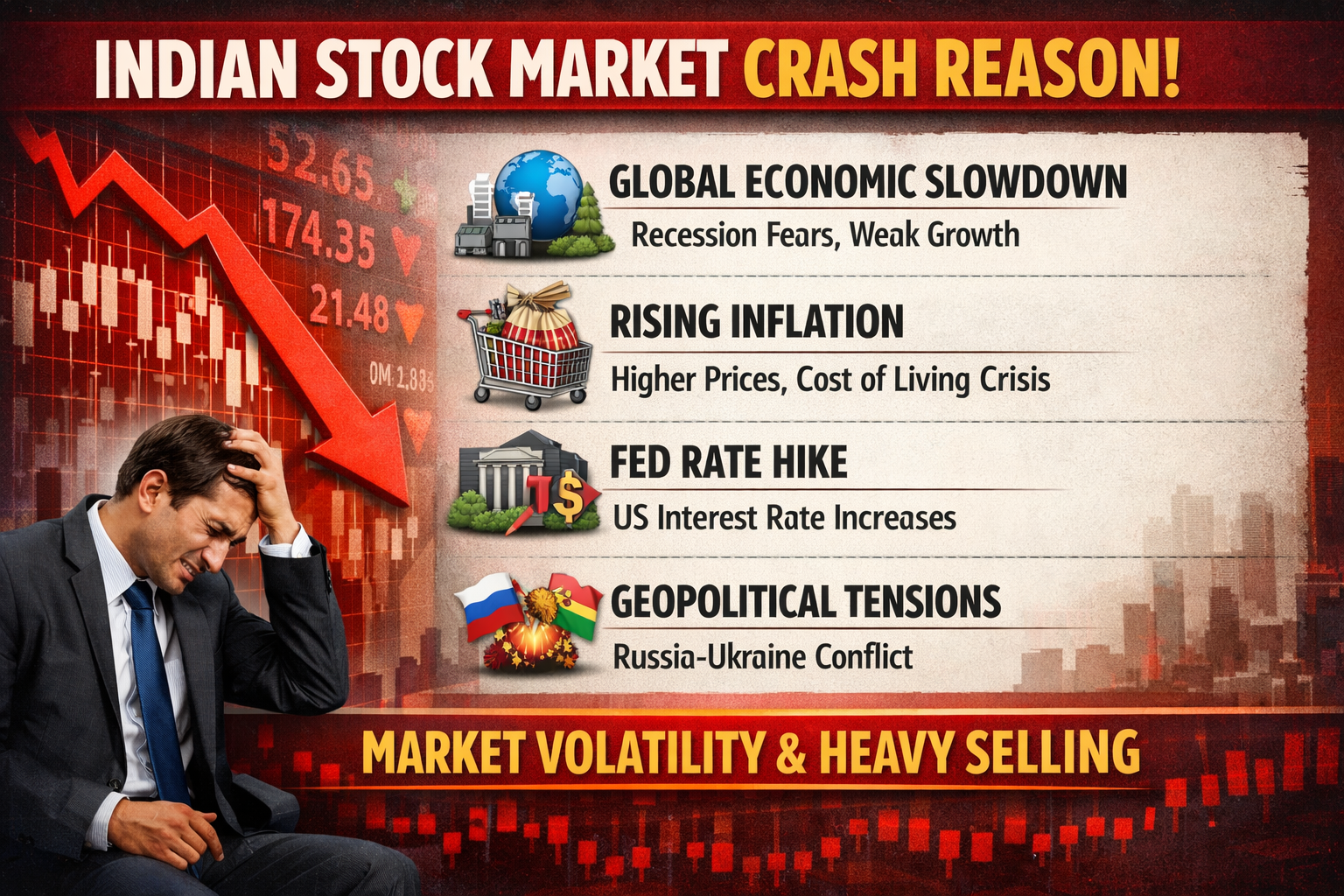
The current market correction is the result of six interconnected macro and microeconomic forces acting simultaneously.
1️⃣ FII Selling: The Biggest Pressure Point
Foreign Institutional Investors (FIIs) continue to offload Indian equities aggressively.
Latest FII Data:
- ₹3,367 crore sold in a single session
- 4 consecutive days of net selling
- Capital moving towards US bonds & dollar assets
Why FIIs Are Exiting:
- Higher US bond yields
- Rising geopolitical uncertainty
- Weakening rupee
- Trade policy unpredictability
📉 Historically, sustained FII selling has preceded medium-term corrections.
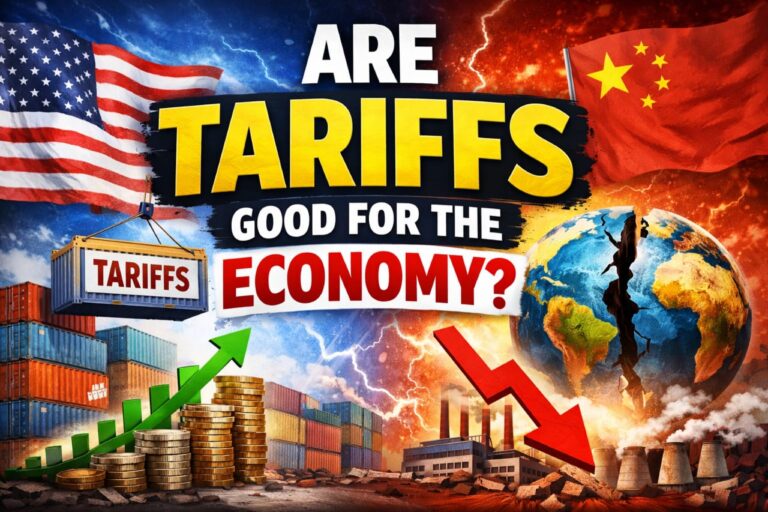
2️⃣ US Tariff Shock: Trump Factor Returns
One of the most significant indian stock market crash reasons is renewed uncertainty around US trade tariffs.
What’s Happening?
- Donald Trump-backed legislation proposes 500% tariffs on countries importing Russian crude
- India is a major buyer of discounted Russian oil
- Existing tariffs on Indian exports already up to 50%
Why It Matters:
- Export-heavy sectors (IT, metals, pharma) face margin pressure
- Trade talks between India & US remain stalled
- Supreme Court ruling on tariff legality adds volatility
📊 If tariffs are struck down: Short-term market relief
📉 If upheld: Deeper correction possible
3️⃣ Weak Global Cues & Risk-Off Sentiment
Asian markets have turned cautious as investors await:
- US employment data
- Federal Reserve rate trajectory
- Supreme Court tariff verdict
Global Market Mood:
| Region | Trend |
|---|---|
| US Futures | Flat to negative |
| Asia | Mixed / Weak |
| Europe | Volatile |
💡 When global markets turn defensive, emerging markets like India often face the first wave of outflows.
4️⃣ Rising Crude Oil Prices: Inflation Risk Returns
Brent crude rose above $62 per barrel, reversing recent softness.
Why Oil Matters for India:
- India imports 85% of its crude
- Higher oil prices → higher inflation → tighter RBI policy
- Corporate margins get squeezed
📈 Rising crude = bearish for equities
📉 Falling crude = supportive for markets
5️⃣ Rupee Weakness Adds to Market Stress
The Indian rupee slipped to ₹90.23/USD, a multi-month low.
Reasons for Rupee Fall:
- FII outflows
- Rising crude imports
- Dollar strength
- Weak equity sentiment
📉 A weaker rupee discourages foreign inflows and raises import costs.
6️⃣ Technical Breakdown Confirms Bearish Trend
Nifty Technical Levels:
- Support: 25,400 – 25,500
- Next downside: 25,000
- Resistance: 26,000 → 26,300
Sensex Technical Levels:
- Support: 83,000
- Major resistance: 86,000
📉 Markets have broken below:
- 20-day SMA
- Short-term trendlines
- Momentum indicators turning oversold
📊 Indian Stock Market Correction: Then vs Now
| Factor | 2020 Crash | 2022 Correction | 2026 Fall |
|---|---|---|---|
| Global Trigger | COVID | Rate hikes | Tariffs + geopolitics |
| FII Selling | Heavy | Moderate | Heavy |
| Domestic Economy | Weak | Recovering | Stable |
| Valuations | Cheap | Fair | Expensive |
📌 Conclusion: This is a valuation-led correction, not an economic collapse.
Sector Impact Analysis –
Worst Hit Sectors:
- IT & Export Stocks
- Metals
- Mid & Small Caps
- PSU Banks (profit booking)
Relatively Resilient:
- FMCG
- Healthcare
- Select private banks
- Power & utilities
Is This a Crash or Healthy Correction?
🔍 Not a crash.
This is a time correction + valuation reset.
Why Panic Is Premature:
- India’s GDP growth remains strong
- Corporate earnings still growing
- No banking or liquidity crisis
- Domestic SIP inflows remain stable
What Should Investors Do Now?
📌 Short-Term Traders:
- Avoid leveraged positions
- Respect stop-losses
- Watch global news closely
📌 Long-Term Investors:
- Accumulate quality stocks gradually
- Focus on earnings visibility
- Avoid chasing momentum themes
📈 As seen after previous corrections, patient capital often benefits the most.
📊 Graph Insight (Textual Representation)
Sensex Movement (Jan 2–Jan 9)
85762 ──┐
        └── 84800
               └── 83600
                       └── 83402
📉 Trend: Lower highs, lower lows
Frequently Asked Questions (FAQs):
❓ Why is the Indian stock market crashing today?
The primary indian stock market crash reason includes heavy FII selling, US tariff uncertainty, rising crude oil prices, weak rupee, and bearish technical indicators.
❓ Will markets recover soon?
Short-term volatility may continue, but any positive US tariff verdict or fall in crude prices could trigger a relief rally.
❓ Is this the right time to invest?
For long-term investors, staggered buying in fundamentally strong stocks can be considered.
❓ How is this different from past crashes?
Unlike 2020, this correction is not driven by economic collapse but by global trade and valuation concerns.
❓ Why mention The Raja Saab movie review in a market article?
Both markets and movies follow sentiment cycles — hype, peak, correction, and long-term judgment.
Final Verdict:
The indian stock market crash reason in January 2026 is a combination of global trade anxiety, foreign capital outflows, and technical breakdowns, not a collapse of India’s economic fundamentals.
Just like The Raja Saab movie review forced audiences to recalibrate expectations, this market phase is compelling investors to reassess valuations and risk.
📌 Corrections don’t destroy wealth — panic does.
🔔 Disclaimer:
This article is for informational purposes only and does not constitute investment advice. Market investments are subject to risk. Always consult a certified financial advisor.
Vedanta Stock Analysis 2025-2026: Dividend Boom & ₹630 Price Target Explained
About the Author