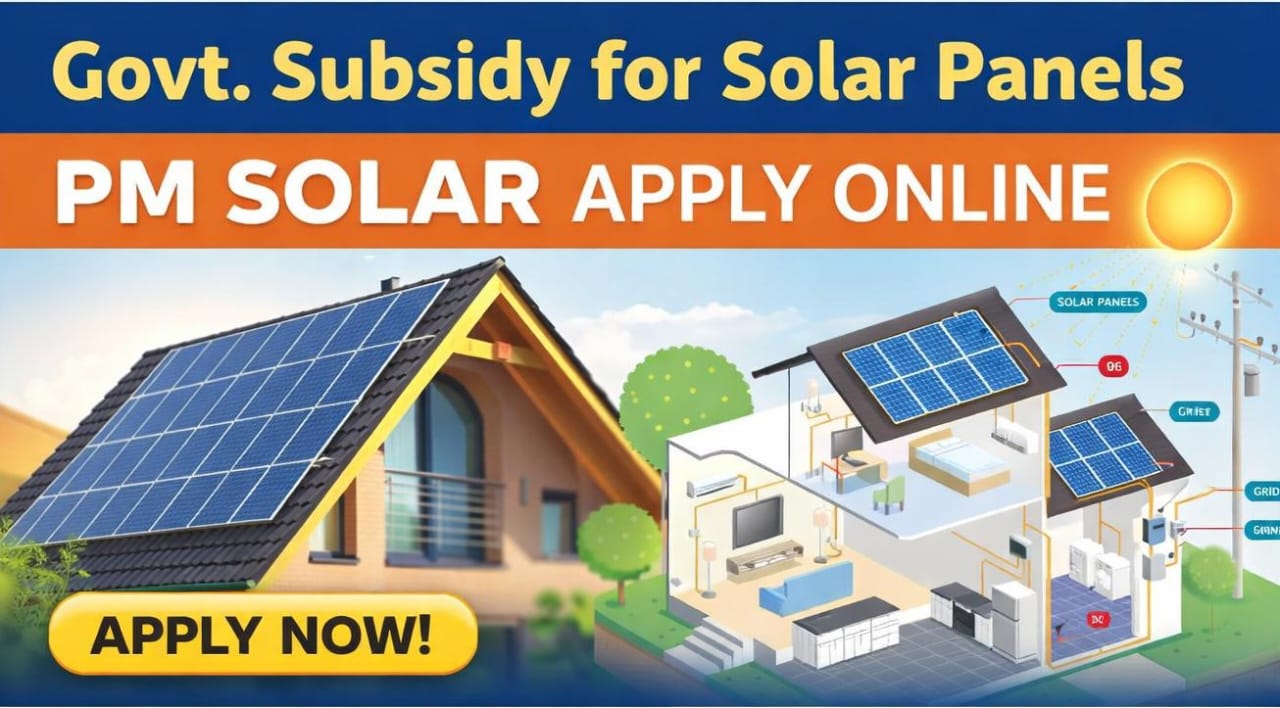
PM Solar Yojana Apply Online 2026: Government Subsidy for Solar Panels Explained
India’s Solar Push in 2026: From Power Bills to Power Generation
India is charging toward its ambitious goal of becoming a net-zero emitter by 2070, and the democratization of solar energy is at the heart of this mission. The PM Surya Ghar Muft Bijli Yojana, launched in 2024, has become the cornerstone of this vision, aiming to light up 1 crore Indian households with rooftop solar power. For millions of homeowners across the country, understanding how to PM Solar Yojana apply online is the first step toward slashing electricity bills to zero and contributing to a greener planet.
For homeowners searching online for pm solar yojana apply online, this guide explains everything—from eligibility and documents to the government subsidy for solar panels 2026, cost-benefit analysis, comparisons with other schemes, and common mistakes to avoid.
This comprehensive guide for 2026 walks you through every step of the online application process, demystifies the government subsidy for solar panels 2026, and provides all the information needed to harness the sun’s power with maximum financial benefit.
Table of Contents:
What Is PM Surya Ghar Muft Bijli Yojana?
The PM Surya Ghar Yojana is a Central Government rooftop solar scheme launched under the Ministry of New and Renewable Energy (MNRE). Its objective is to install grid-connected rooftop solar systems in 1 crore residential homes across India.
The scheme enables households to:
- Produce their own electricity
- Export excess power to the grid
- Receive direct government subsidies
- Achieve near-zero electricity bills
In simple terms, it turns electricity consumers into electricity producers.
Key Objectives of PM Solar Yojana in 2026
The 2026 roadmap of the scheme focuses on both economic relief and environmental impact.
Main Goals –
- Provide free or very low-cost electricity to Indian households
- Reduce dependence on coal-based power
- Lower household electricity expenses permanently
- Support India’s Net Zero by 2070 commitment
- Encourage domestic solar manufacturing
- Create employment in the green energy sector
Tata Solar Panel Price with Subsidy in India (2026)
Government Subsidy for Solar Panels 2026: Latest Structure
The biggest attraction of the scheme is the direct financial subsidy, credited straight to the beneficiary’s bank account.
Central Subsidy Structure (FY 2025–26) –
| Rooftop Solar Capacity | Subsidy Rate | Maximum Subsidy |
|---|---|---|
| Up to 2 kW | ₹30,000 per kW | ₹60,000 |
| 2 kW to 3 kW | ₹18,000 per kW (additional) | ₹78,000 |
| Above 3 kW | Fixed (for first 3 kW only) | ₹78,000 |
🔹 Important:
The government subsidy for solar panels 2026 is capped at ₹78,000, even if system size exceeds 3 kW.
Additional Financial Benefits:
Beyond the central subsidy, applicants can benefit from:
1. Bank Loan Facility
- Loans available for the unsubsidized portion
- Interest rates around 6.5%–7.5%
- Tenure up to 10 years
2. State-Level Subsidies
Some states provide additional incentives on top of the central scheme.
| State | Extra Benefit |
|---|---|
| Gujarat | Additional state subsidy |
| Maharashtra | Net metering incentives |
| Rajasthan | Faster approvals |
| Kerala | Interest subvention |
(State benefits vary and are subject to annual policy updates.)
Who Can Apply? Eligibility Criteria Explained
Before you start pm solar yojana apply online, make sure you meet the eligibility conditions.
Eligibility Checklist –
- You must be an Indian citizen.
- You must own a residential property (owned or rented with owner’s consent) with a suitable rooftop.
- You must have a valid electricity connection in your name.
- You should not have availed of any other central subsidy for rooftop solar previously on the same property.
- Your average monthly electricity consumption should ideally be between 300-500 units for a 3kW system to maximize benefits.
Ideal Electricity Consumption –
| System Size | Monthly Units |
|---|---|
| 1 kW | 100–150 units |
| 2 kW | 200–300 units |
| 3 kW | 300–500 units |
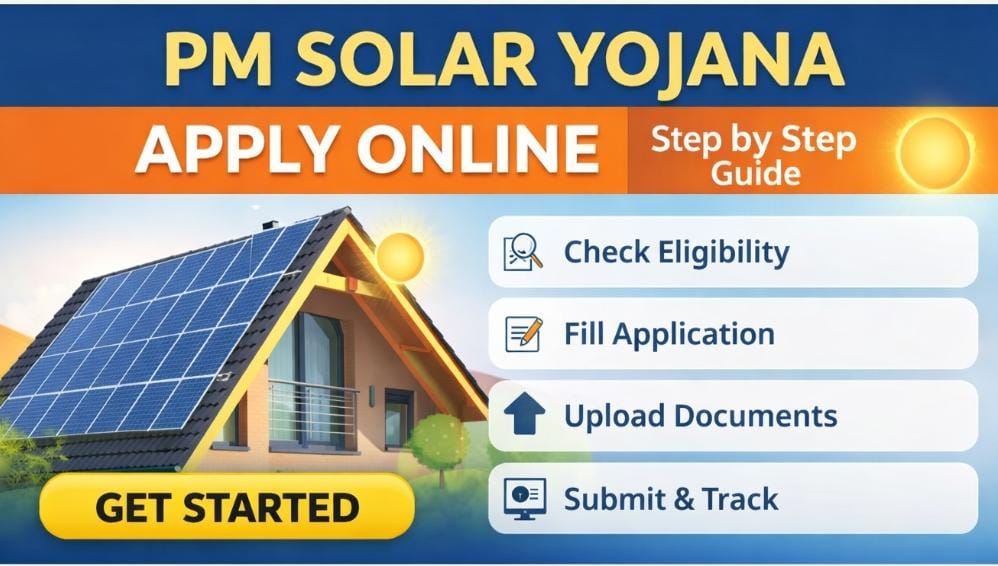
Step-by-Step Process: PM Solar Yojana Apply Online
The entire application is 100% online and transparent.
Step 1: Registration on the National Portal
- Visit the official portal: https://pmsuryaghar.gov.in
- Click on the “Apply for Rooftop Solar” or “Register Now” button.
- Select your State and Electricity Distribution Company (DISCOM) (e.g., BSES Rajdhani, MSEDCL, TSSPDCL).
- Enter your Electricity Consumer Number (from your bill) and registered mobile number.
- Click on “Get Details” to auto-fill your name and address.
- Create a login password. You will receive an OTP for verification.
Step 2: Application Form Submission
After logging into your dashboard:
- Fill in the detailed application form with:
- Personal details (Aadhaar, bank account info for subsidy transfer).
- Property details (roof type, area).
- Preferred system capacity (1kW, 2kW, 3kW, etc.) based on your monthly consumption. The portal often has a calculator to help you decide.
- Upload the necessary documents (scanned copies):
- Identity Proof: Aadhaar Card
- Address Proof: Recent electricity bill
- Ownership Proof: Registry document, tax receipt, or affidavit if rented
- Bank Account Details: Cancelled cheque or bank passbook
- Rooftop Photo
Step 3: Choose an Empanelled Vendor
Once your application is preliminarily approved by your DISCOM, you will gain access to the list of government-empanelled vendors in your area on the portal.
- Compare quotes from 2-3 vendors.
- Check their ratings, experience, and warranty terms (typically 25 years for panels, 5-10 years for inverters).
- Select your preferred vendor and proceed with a formal agreement.
Step 4: Installation and Net Metering
- The selected vendor will conduct a site survey and finalize the design.
- Upon your approval, they will install the rooftop solar system.
- The vendor will also apply for the net meter on your behalf. This bi-directional meter records both the electricity you draw from the grid and the excess solar power you export to it.
Step 5: Inspection and Subsidy Disbursement
- After installation, a technical inspection is conducted by your DISCOM.
- Once the installation is verified and the net meter is connected, the vendor submits the commissioning report on the portal.
- The government subsidy for solar panels 2026 is then directly credited to your registered bank account within 30-45 days.
Documents Required for Online Application
Keep these documents ready before you start your online application:
| Document Type | Details |
|---|---|
| Identity Proof | Aadhaar Card |
| Address Proof | Latest electricity bill |
| Ownership Proof | Registry / Tax receipt / NOC |
| Bank Proof | Cancelled cheque / passbook |
| Technical | Rooftop photograph |
Cost vs Savings: Is It Worth It in 2026?
Example: 3 kW Rooftop Solar System
| Component | Amount (₹) |
|---|---|
| Total Cost | 1,65,000 – 2,10,000 |
| Central Subsidy | 78,000 |
| Net Cost | 87,000 – 1,32,000 |
| Annual Generation | 4,200 – 4,800 units |
| Annual Savings (@₹8/unit) | 33,600 – 38,400 |
| Payback Period | 2.5 – 4 years |
| 25-Year Savings | ₹8–10 lakh |
Verdict
From a financial perspective, pm solar yojana apply online is one of the highest ROI investments for Indian households in 2026.
PM Surya Ghar vs Other Solar Schemes
| Scheme | Target Group | Subsidy Type |
|---|---|---|
| PM Surya Ghar | Homeowners | Central subsidy |
| MNRE Phase-II | Residential | Limited subsidy |
| PM-KUSUM | Farmers | Central + State |
| State Solar Schemes | State residents | State subsidy |
For homeowners, PM Surya Ghar clearly offers the best benefits.
Solar Panel Price in India 2026: Complete Cost Guide (1kW, 3kW, 5kW, 10kW + With Subsidy)
Frequently Asked Questions (FAQs)
Q1: What is the official website to PM Solar Yojana apply online?
A1: The only official website is https://pmsuryaghar.gov.in. Beware of fraudulent third-party sites.
Q2: Can I apply if I live in a rented house or an apartment?
A2: Yes, but with conditions.
- Rented House: You need a No Objection Certificate (NOC) from the house owner and proof of a long-term lease.
- Apartment: If you have an individual rooftop right, you can apply. For common areas, the Resident Welfare Association (RWA) must apply as a group.
Q3: How long does the entire process take, from application to subsidy receipt?
A3: The timeline is approximately:
- Application Approval: 1-2 weeks
- Installation after vendor selection: 1-2 weeks
- Net Metering & Inspection: 2-4 weeks
- Subsidy Disbursement: 30-45 days post-inspection.
Total: ~2.5 to 4 months.
Q4: What happens to the excess solar power I generate?
A4: Through net metering, the excess power is fed back into the grid. Your DISCOM gives you credits for this export. These credits offset your consumption during night-time or cloudy days, leading to a near-zero bill.
Q5: Is the subsidy taxable?
A5: No. No. The government subsidy for solar panels 2026 is not taxable.
Q6: What if my DISCOM is not listed on the portal?
A6: The scheme is being rolled out in phases. If your DISCOM isn’t listed, it might not be integrated yet. Contact your local electricity office for updates or check the portal periodically for additions.
Common Mistakes to Avoid:
- Incorrect Consumer Number: Double-check the number on your electricity bill.
- Bank Account Mismatch: Ensure the bank account name matches the electricity connection name.
- Poor Rooftop Photos: Upload clear, wide-angle photos showing the entire roof space.
- Choosing the Cheapest Vendor: Prioritize quality and warranty over the lowest quote. Check vendor ratings on the portal.
- Ignoring State Subsidies: After applying for the central scheme, inquire with your state energy department about additional incentives.
Final Thoughts: Why 2026 Is the Best Time to Go Solar
With rising power tariffs, generous subsidies, easy online access, and long-term savings, there has never been a better time to switch to rooftop solar. The pm solar yojana apply online process is simple, transparent, and designed for mass adoption.
The government subsidy for solar panels 2026 reduces upfront costs dramatically, making solar power accessible to middle-class and lower-income households alike.
🌞 One decision today can secure 25 years of savings tomorrow.
Apply online, harness the sun, and take control of your electricity future.
About the Author