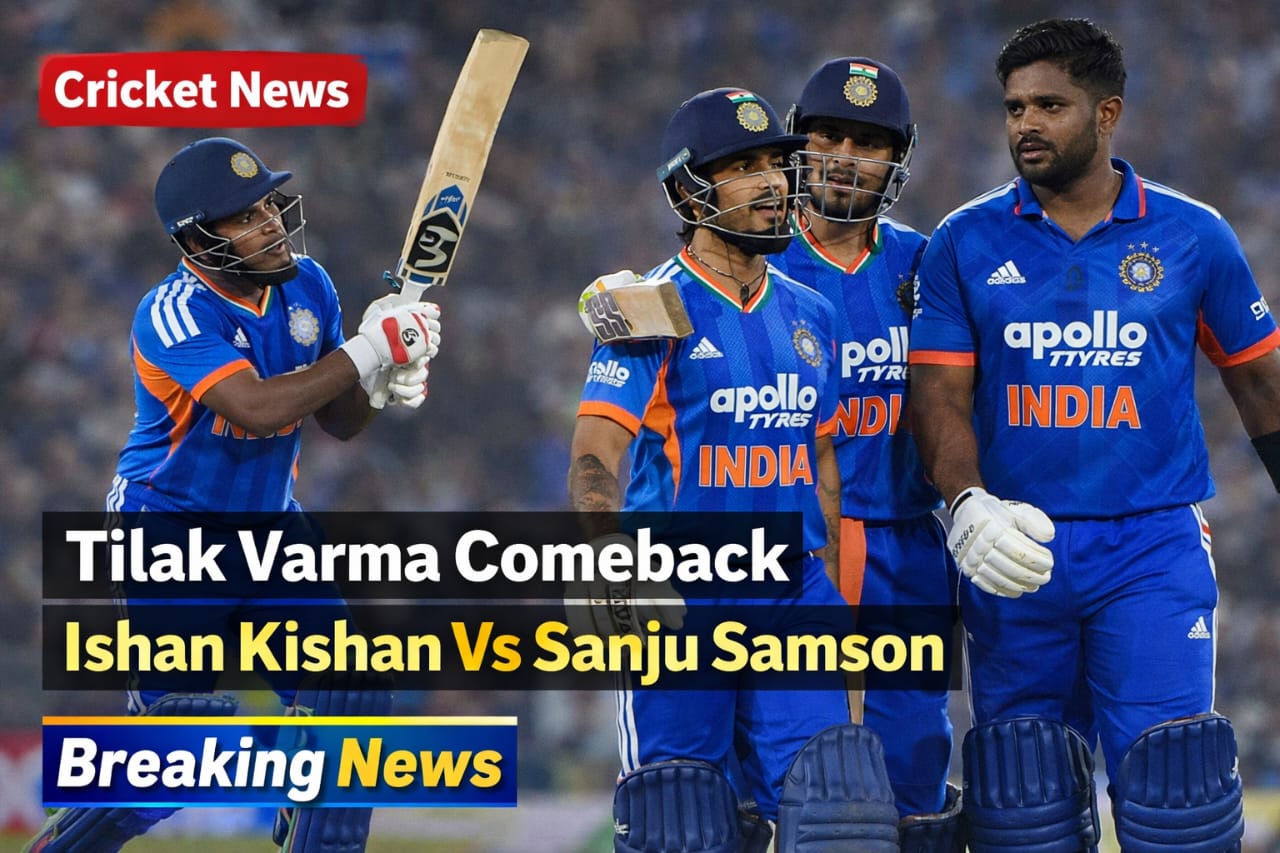
Ishan Kishan vs Sanju Samson: India’s Top-Order Dilemma as Tilak Varma Returns
The debate around Ishan Kishan vs Sanju Samson has resurfaced with force, and this time it refuses to be reduced to a simple comparison of runs scored. India’s second T20I against New Zealand did more than tilt a match — it reopened a selection file the team management believed was temporarily closed.
Sanju Samson’s quiet returns and Ishan Kishan’s explosive response have created a genuine dilemma. Add to this the Tilak Varma Returns, and India’s top-order equation suddenly looks unstable, uncertain, and deeply strategic.
This is not about one bad series or one great innings. It is about structure, balance, and predictability — the three pillars on which modern T20 success is built.
Table of Contents:
Why the New Zealand Series Matters?
Bilateral T20 series often carry the label of experimentation, but this one carries extra weight. With the T20 World Cup 2026 on the horizon, India are no longer testing players — they are testing combinations.
Tilak Varma’s injury-enforced absence opened a temporary window. Ishan Kishan walked into it. Sanju Samson was already inside it. Only one may walk out comfortably when Tilak Varma returns.
That is what makes this series more than just another fixture on the calendar.
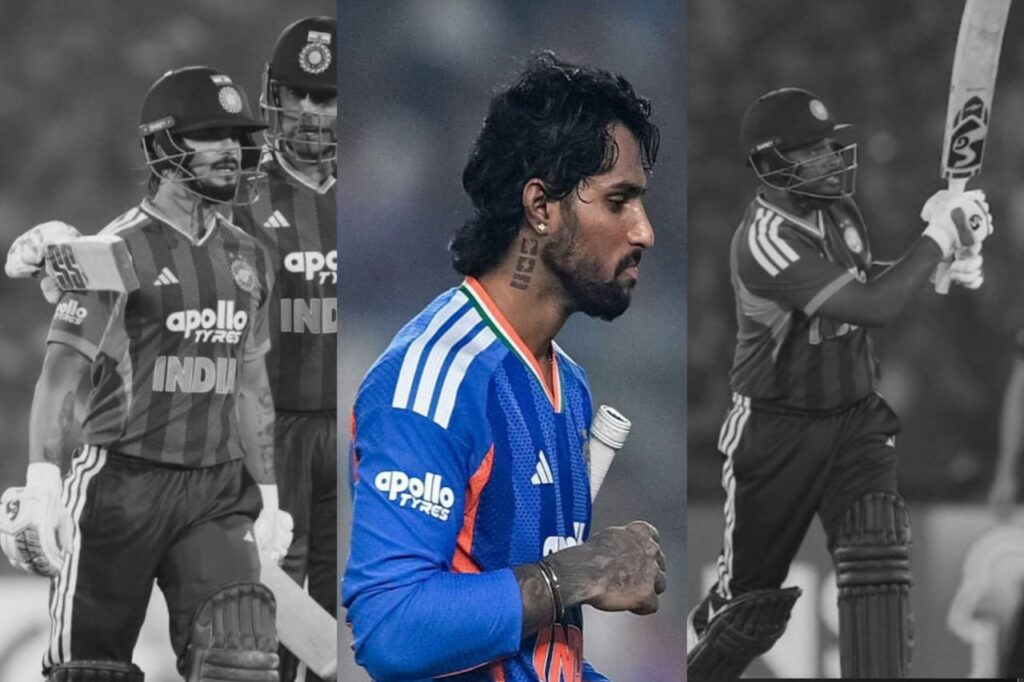
Sanju Samson’s Role Beyond Runs
Sanju Samson is not in the XI purely as a batter. His value lies in what he prevents, not just what he produces.
He offers:
- A right-handed option in a left-heavy top order
- A wicketkeeping solution
- Powerplay flexibility
- Matchup disruption against left-arm bowling
This makes Samson a structural pick, not a form pick.
When he succeeds, the top order looks layered. When he fails early, the entire shape collapses faster than the scoreboard suggests.
Why Samson Is Judged More Harshly?
Sanju Samson’s dismissals attract more scrutiny because they cost India two things at once:
- A wicket
- Tactical balance
India’s current T20 batting core leans left:
- Abhishek Sharma – Left
- Tilak Varma – Left
- Several middle-order options – Left
Samson is the natural right-handed interruption. When he falls early, India lose their ability to force bowling changes in the powerplay.
That dual loss is why Samson’s failures feel louder than others.
Ishan Kishan’s Knock That Changed the Conversation
Ishan Kishan’s 76 off 32 balls in the second T20I wasn’t just a good innings. It was a selection-altering innings.
Batting at No. 3, Kishan showed:
- Immediate intent
- Clean power against pace and spin
- Boundary conversion in the powerplay
In a single knock, Kishan reminded the selectors that he offers:
- Top-order aggression
- Wicketkeeping
- Left-handed dominance
This is why Ishan Kishan vs Sanju Samson is now unavoidable again.
Samson vs Kishan in T20Is:
| Metric | Sanju Samson | Ishan Kishan |
|---|---|---|
| T20I Matches | 25+ | 50+ |
| Avg Strike Rate | ~135 | ~125 |
| Powerplay Dismissals (Recent) | High | Moderate |
| Boundary % | Medium | High |
| Batting Positions | Opener / No.3 | Opener / No.3 |
| Wicketkeeping | Yes | Yes |
Insight:
Samson offers balance; Kishan offers volume and momentum.
The Tilak Varma Comeback: The Real Inflection Point
Everything changes with the Tilak Varma comeback.
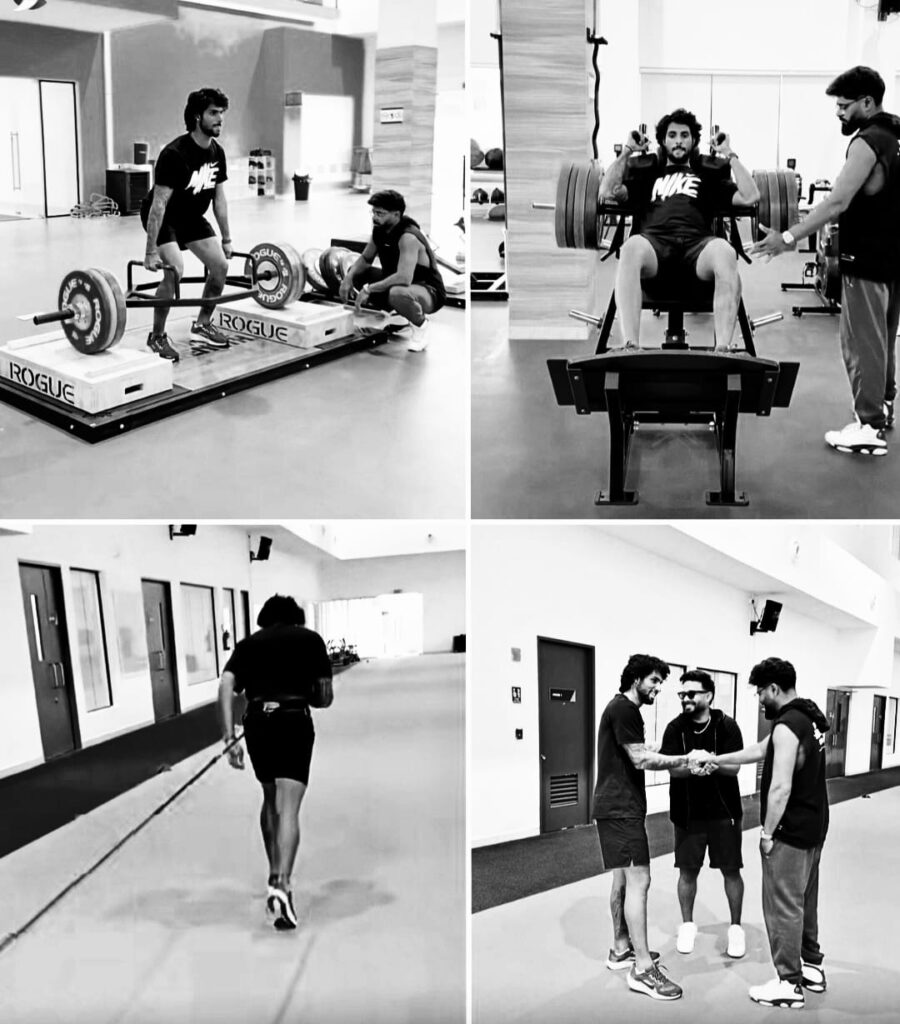
Tilak is not a floating option. He is a locked top-four batter when fit. His return squeezes the middle.
Once Tilak Varma returns, India’s likely structure becomes:
- Opener
- Opener / No.3
- Tilak Varma
- Suryakumar Yadav
That leaves one slot, not two.
What Happens When Tilak Varma Returns?
When Tilak Varma returns, India face a stark choice:
- Preserve right-left balance
- Or maximize individual form
This is where the Ishan Kishan vs Sanju Samson debate becomes philosophical.
Dropping Samson risks:
- Left-left-left top order
- Predictable powerplay plans
Dropping Kishan risks:
- Losing recent momentum
- Ignoring form
Neither choice is clean.
Left-Right Balance: Why It Still Shapes Selection
Left-right combinations are not cosmetic. They affect:
- Bowling angles
- Field placements
- Over-by-over plans
A left-heavy top three allows opponents to:
- Start with left-arm pace
- Stack one side of the field
- Bowl repeatable lengths
At World Cup level, “easy to plan against” becomes a serious flaw.
This is where Samson’s argument survives even with modest scores.
Tactical Matchups in the Powerplay
With Samson:
- Opponents forced to rotate bowlers
- Fielding captains adjust mid-over
- Less control in early overs
Without Samson:
- Clear bowling scripts
- Repetitive angles
- Easier containment plans
This tactical layer is why India hesitate to make knee-jerk changes.
Voices from the Game: What Experts Are Saying?
Former India opener Kris Srikkanth summed up the pressure succinctly:
“Sanju is under pressure. He is looking desperate. When you become desperate, you become greedy.”
The criticism is not about talent. It is about decision-making under competition.
Possible Top-Order Combinations Explained
Option 1: Balance-First Approach
- Abhishek Sharma (L)
- Sanju Samson (R)
- Tilak Varma (L)
- Suryakumar Yadav (R)
Pros: Tactical balance
Cons: Samson’s form risk
Option 2: Form-First Approach
- Abhishek Sharma (L)
- Ishan Kishan (L)
- Tilak Varma (L)
- Suryakumar Yadav (R)
Pros: Explosive starts
Cons: Predictability
Option 3: Hybrid Solution
- Abhishek Sharma (L)
- Ishan Kishan (L)
- Suryakumar Yadav (R)
- Tilak Varma (L)
Pros: Preserves right-hander
Cons: Tilak pushed down
Scenario Analysis Table:
| Scenario | Samson | Kishan | Balance | Risk Level |
|---|---|---|---|---|
| Short-term Series | In | Out | High | Medium |
| Tilak Varma Returns | In | Out | High | Medium |
| Samson Fails Repeatedly | Out | In | Low | High |
| Hybrid Model | Out | In | Medium | Medium |
World Cup 2026 Lens: Short-Term vs Long-Term Thinking
With the T20 World Cup in mind, India must answer:
- Do we optimize for now?
- Or for the hardest-to-bowl-against XI?
The Tilak Varma comeback makes this decision unavoidable. Once Tilak Varma returns, experimentation ends.
Who Should India Back and Why?
India should not rush to drop Sanju Samson purely on the back of one big Ishan Kishan innings.
However, Samson’s selection can no longer be unconditional.
The right call:
- Retain Samson through the immediate window
- Treat the post–Tilak Varma returns phase as a final audition
- Demand visible powerplay involvement, not just intent
If Samson continues to fall early, India must move on — but without sacrificing right-handed balance.
The solution is not Samson vs Kishan.
It is predictability vs complexity.
FAQs (Q&A Section)
Q1. Is Ishan Kishan ahead of Sanju Samson now?
Not definitively. Kishan’s innings strengthens his case, but team balance still favors Samson.
Q2. Why is Tilak Varma so central to this debate?
The Tilak Varma comeback compresses the top order, turning a rotation into a direct contest.
Q3. Can India play both Kishan and Samson?
Only temporarily. Once Tilak Varma returns, one will likely sit out.
Q4. What is the biggest risk of dropping Samson?
A left-heavy top order that becomes easier to plan against.
Q5. Who benefits most if Samson is dropped?
Ishan Kishan in the short term — but opposition bowlers in the long term.
Conclusion:
The Ishan Kishan vs Sanju Samson debate is not about who hits harder. It is about who makes India harder to bowl to — especially when Tilak Varma returns.
About the Author