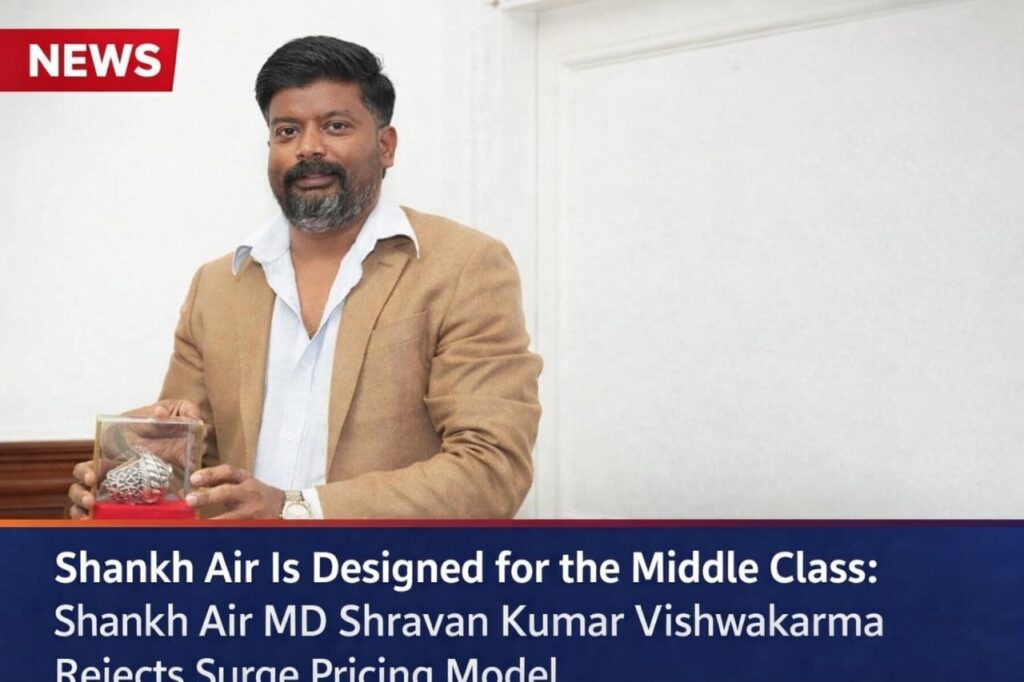
Shankh Air Is Designed for the Middle Class: Shankh Air MD Shravan Kumar Vishwakarma Rejects Surge Pricing Model
In the high-stakes world of Indian aviation, where deep corporate pockets and political connections often dictate success, emerges a story that defies every convention. At the center stands Shankh Air MD Shravan Kumar Vishwakarma—a man whose journey from Kanpur’s streets to the cockpit of airline entrepreneurship reads like a script from an inspiring biopic. With a planned April 2026 launch, Shankh Air isn’t just another new airline in India; it’s a socio-economic statement packaged as a transportation business, promising revolutionary “no surge pricing” and positioning itself squarely as a middle-class airline India can truly call its own.
This comprehensive profile explores how Vishwakarma’s ground-level experience, unconventional philosophy, and middle-class empathy could potentially rewrite the rules of Indian aviation.
The Man Behind the Mission: Who is Shravan Kumar Vishwakarma?
From Auto Driver to Airline Founder: The Rise of Shankh Air MD
Shankh Air MD Shravan Kumar Vishwakarma’s journey into Indian aviation is unlike anything the industry has seen before. A Class 10 pass from Kanpur, who once earned his living driving autorickshaws and tempos, Vishwakarma is now preparing to launch Shankh Air, a full-service airline scheduled to begin operations in April 2026.
In an exclusive conversation with News18, the Managing Director made it clear that Shankh Air is not built for elite travelers, but for India’s vast middle-class population that still sees flying as a luxury.
“An airplane is just another means of transport. It should not be exclusive,” Vishwakarma said.
Shankh Air MD Shravan Kumar Vishwakarma‘s biography challenges the typical pedigree of airline founders. Unlike the MBAs, legacy industrialists, or corporate professionals who usually dominate aviation, Vishwakarma’s education ended at Class 10, and his early career involved hands-on work in India’s informal transport sector.
Once a Tempo Driver, Now an Airline Founder: Shankh Air Owner’s Unbelievable Journey
Table: The Evolution of Shankh Air MD Shravan Kumar Vishwakarma
| Life Phase | Primary Occupation | Skills Developed | Capital Status |
|---|---|---|---|
| 1990s: Survival Years | Auto-rickshaw & tempo driver | Navigation, customer service, logistics | Hand-to-mouth |
| Early 2000s: Trader Phase | Cement and TMT steel trading | Supply chain, negotiation, market cycles | Small-scale capital |
| 2010s: Industrial Expansion | Mining and logistics operator | Fleet management, regulatory compliance | Medium enterprise level |
| 2020s: Aviation Preparation | Airline founder-in-waiting | DGCA regulations, aircraft economics | Substantial backing secured |
The Mindset: Why Experience Matters ?
What sets Shankh Air MD Shravan Kumar Vishwakarma apart is his philosophical approach to transportation:
- Ground-Up Understanding: Having actually driven vehicles for a living, he understands the psychology of passengers seeking value
- Logistics Expertise: Managing 400+ vehicles taught him operational efficiency at scale
- Middle-Class Empathy: Coming from modest means, he intrinsically understands the budget constraints of his target market
“An airplane is just another means of transport. It should not be exclusive,” Vishwakarma asserts—a statement that encapsulates his entire approach.
The Shankh Air Proposition: More Than Just Another Airline
The Revolutionary Pricing Model –
While most airlines employ complex algorithmic pricing that maximizes revenue per seat, Shankh Air proposes something radically simple: uniform pricing.
Graph: Comparative Pricing Models During Festival Season
[Visual showing three lines:
- Traditional Airlines: Steep peak during festivals (300%+ increase)
- Low-Cost Carriers: Moderate peak (150-200% increase)
- Shankh Air: Flat line (no increase)]
What Shankh Air Promises –
One of the boldest claims made by Shankh Air is its complete rejection of dynamic or surge pricing — a pricing model widely used by airlines worldwide.
- ❌ No festival surge
- ❌ No last-minute price spikes
- ❌ No demand-based fare manipulation
- ✅ Uniform ticket prices throughout the year
According to Vishwakarma, passengers will only pay the actual cost of transportation, making Shankh Air potentially the world’s first airline without dynamic pricing.
“Whether it is a festival or a normal day, fares will remain the same,” Shankh Air MD Shravan Kumar Vishwakarma said.
“Passengers will only pay the actual cost of transportation,” Vishwakarma states, challenging the fundamental revenue management principles taught in aviation business schools worldwide.
Full Service, Not Low Cost: A Critical Distinction
Unlike many budget carriers that unbundle services to appear affordable, Shankh Air positions itself differently:
Table: Shankh Air vs. Traditional Models
| Service Aspect | Low-Cost Carrier | Full-Service Carrier | Shankh Air Model |
|---|---|---|---|
| Base Fare | Appears low | Higher | Middle-ground |
| Baggage | Paid add-on | Included | Included |
| Meals | Paid add-on | Included | Included |
| Seat Selection | Paid add-on | Often included | Likely included |
| Change Flexibility | High fees | Moderate fees | To be determined |
| Pricing Dynamics | High surge | Very high surge | No surge |
This “affordable full-service” model aims to deliver dignity alongside affordability—a combination Vishwakarma believes the middle class deserves but rarely receives.
The Business Foundation: How Shankh Air Stands on Solid Ground?
Funding Architecture: Diversified and Practical
Aviation ventures often fail due to undercapitalization. Shankh Air MD Shravan Kumar Vishwakarma addresses this through a multi-pronged approach:
Funding Sources:
- Foreign Debt Financing: Loans from international banks with aviation portfolio experience
- Parent Company Backing: Support from Vishwakarma’s established trading and logistics businesses
- Strategic Partnerships: Overseas associates and NRI investments
- Conservative Reserves: Capital specifically allocated for initial operational stability
“Financially, we are on solid ground,” Vishwakarma emphasizes, suggesting a war chest designed to withstand early turbulence.
Operational Advantages from Logistics Experience –
Shankh Air MD Shravan Kumar Vishwakarma‘s background provides unique operational insights:
- Fleet Management Expertise: Scaling from 1 to 400+ vehicles teaches maintenance scheduling and utilization optimization
- Fuel Management: Logistics experience with volatile diesel prices translates to understanding aviation fuel dynamics
- Route Planning: Ground transportation experience in optimizing routes for efficiency
- Regulatory Navigation: Experience with transportation regulations provides framework for aviation compliance
Market Analysis: Why This Model Might Work Now?
The Middle-Class Aviation Gap –
India’s aviation story has largely been binary: ultra-low-cost options with hidden charges or premium services with prohibitive pricing. The missing middle is precisely where Shankh Air positions itself.
Table: India’s Air Traveler Segmentation (2026 Projection)
| Segment | Approximate Size | Current Options | Pain Points |
|---|---|---|---|
| Price-Sensitive First Timers | 40-50 million | LCCs with add-ons | Unpredictable final cost, surprise charges |
| Regular Middle-Class Travelers | 20-30 million | Mix of LCCs & full-service | Fare volatility, last-minute spikes |
| Business/Elite Travelers | 5-10 million | Full-service carriers | Cost less concern, seeking consistency |
| Untapped Potential Market | 100+ million | None (non-flyers) | Perceives flying as unaffordable luxury |
Shankh Air primarily targets segments 1 and 2, with potential to tap into segment 4—Shankh Air MD Shravan Kumar Vishwakarma‘s most ambitious goal.
Regional Connectivity: The Uttar Pradesh Advantage
With Uttar Pradesh as its operational focus, Shankh Air leverages:
- Demographic Dividend: UP’s 230+ million population represents massive untapped demand
- Infrastructure Growth: Improving airport infrastructure in secondary cities
- Political Support: Likely alignment with regional connectivity initiatives
- Founder’s Insight: Vishwakarma’s intrinsic understanding of UP’s travel patterns
The Launch Roadmap: April 2026 and Beyond
Phase 1: Establishment (2026-2027)
- Initial Fleet: 5 Airbus A320 aircraft
- Hub Strategy: Primary base in Uttar Pradesh, likely Lucknow or Prayagraj
- Network Design: Metro connections (Delhi, Mumbai, Bangalore) + intra-UP connectivity
- Brand Building: Establishing “predictable pricing” as core identity
Phase 2: Expansion (2028-2029)
- Fleet Growth: 15-18 aircraft
- Network Expansion: Pan-India coverage with emphasis on tier-2 cities
- Service Enhancement: Loyalty program, partnerships
- International Foray: SAARC region routes
Phase 3: Maturation (2030-2031)
- Fleet Target: 30+ aircraft
- Market Position: Established as major pan-India carrier
- Business Model Validation: Proof of sustainable no-surge pricing
- Industry Influence: Potential catalyst for broader pricing reforms
Potential Challenges and Counterarguments:
The Sustainability Question –
Critics might question whether the no-surge model can withstand:
- Fuel Price Volatility: Aviation turbine fuel constitutes 30-40% of operational costs
- Market Competition: Established carriers might launch price wars on key routes
- Operational Disruptions: Weather, technical issues, or slot constraints affect efficiency
- Economic Cycles: Recessions or reduced travel demand impact load factors
Shankh Air MD Shravan Kumar Vishwakarma‘s counter: “Our logistics experience with similar challenges gives us unique preparedness. We understand how to maintain operations through volatility.”
The Full-Service Affordability Equation –
Can Shankh Air truly provide full-service amenities at near-low-cost fares? The answer likely lies in:
- High Aircraft Utilization: Maximizing daily flying hours
- Operational Efficiency: Leveraging ground handling expertise from logistics business
- Ancillary Revenue: While maintaining transparent core pricing, optional services might contribute
- Volume Focus: Banking on higher load factors rather than higher fares
Comparative Analysis: Shankh Air vs. Indian Aviation History
Previous Disruptors and Lessons –
Table: Comparison with Notable Indian Airline Startups
| Airline | Launch Era | Key Innovation | Outcome | Relevance to Shankh Air |
|---|---|---|---|---|
| Air Deccan | 2003 | Ultra-low-cost flying | Acquired, model diluted | Demonstrated mass market potential |
| IndiGo | 2006 | Operational efficiency & consistency | Market leader | Proved importance of predictability |
| Vistara | 2015 | Full-service with value | Merged with Air India | Showed market for quality service |
| Akasa Air | 2022 | Young fleet, employee focus | Growing steadily | Proves new entrants can succeed |
| Shankh Air | 2026 (planned) | No-surge pricing, middle-class focus | To be determined | Unique pricing philosophy |
What Shankh Air Learns from Predecessors –
- From Air Deccan: Don’t compromise on operational reliability while pursuing low costs
- From IndiGo: Consistency in service delivery builds brand trust
- From Vistara: There’s appetite for quality service outside elite travelers
- From Akasa: Employee culture and young fleet matter
Industry Impact: Potential Ripple Effects
If Shankh Air Succeeds…
- Pricing Pressure: Competitors might need to moderate surge pricing extremes
- Market Expansion: Could catalyze faster growth of middle-class air travel
- Regional Development: Enhanced air connectivity could boost UP’s economy
- Philosophical Shift: Might inspire more businesses targeting India’s aspirational classes
If Shankh Air Struggles…
- Validation of Status Quo: Would reinforce current pricing models as “inevitable”
- Investor Caution: Could make funding future aviation startups more difficult
- Missed Opportunity: Middle-class travelers continue with unpredictable fare structures
FAQ: Everything You Need to Know About Shankh Air
Q: Who exactly is Shankh Air MD Shravan Kumar Vishwakarma?
A: A first-generation entrepreneur from Kanpur with background in transportation and trading, now venturing into aviation with a distinct middle-class focused philosophy.
Q: How will Shankh Air maintain uniform pricing when costs fluctuate?
A: Through hedging strategies, operational efficiencies from logistics experience, and potentially averaging costs across peak and lean periods—similar to how public transport systems price tickets.
Q: Isn’t “no surge pricing” just a marketing gimmick?
A: Vishwakarma stakes his entire brand identity on this promise. While the exact implementation will be tested, his background suggests he understands the operational implications deeply.
Q: What makes Vishwakarma qualified to run an airline?
A: While lacking aviation-specific experience, he brings decades of transportation operations, fleet management, and business scaling experience—transferable skills that many traditional airline founders lack.
Q: How can passengers trust this model will last?
A: The April 2026 launch will provide initial evidence. Sustainability will depend on operational execution and whether the model attracts sufficient passenger volume.
Q: Will Shankh Air have modern digital systems for booking and management?
A: While not detailed in initial announcements, any contemporary airline requires robust digital infrastructure. Vishwakarma’s understanding of modern business suggests this will be addressed.
Q: What happens during extreme situations like fuel price spikes?
A: This remains the model’s greatest test. Vishwakarma likely anticipates such scenarios given his logistics background where fuel volatility is constant.
The Bigger Picture: Social Impact and Symbolism
Redefining Indian Entrepreneurship –
Shankh Air MD Shravan Kumar Vishwakarma represents a new archetype of Indian entrepreneur:
- Non-elite Background: Proves business leadership isn’t confined to certain communities or educations
- Sector-Jumping Courage: Moving from road transport to aviation demonstrates remarkable ambition
- Socially-Informed Business: Building a company specifically for India’s largest but often underserved demographic
Aviation as Social Mobility Vehicle –
Beyond transportation, Shankh Air symbolizes:
- Democratization of Air Travel: Making flying truly mainstream in India
- Geographic Inclusion: Connecting India’s heartland to economic centers
- Aspirational Accessibility: Enabling middle-class families to fly without financial anxiety
Conclusion: The Conch Shell That Might Just Sound a Revolution
As the aviation world watches and skeptics analyze, Shankh Air MD Shravan Kumar Vishwakarma prepares for what might be Indian aviation’s most intriguing experiment. His journey from auto rickshaw to Airbus command symbolizes more than personal success—it represents a potential paradigm shift in how airlines perceive their relationship with passengers.
The no-surge pricing model challenges fundamental industry assumptions about revenue optimization. The middle-class focus questions who aviation truly serves. The founder’s background redefines who can lead in capital-intensive sectors.
Whether Shankh Air becomes a lasting success or a noble experiment, its very conception has already achieved something important: it has made us question why air travel must be unpredictable in cost, why certain demographics are overlooked, and whether there might be a better way.
As Shankh Air MD Shravan Kumar Vishwakarma himself puts it with characteristic simplicity: “Even if I fall, I’ll still be far ahead of where I started.” This freedom from fear of failure might just be the ingredient that allows Shankh Air to attempt what others wouldn’t dare.
Come April 2026, India’s middle class—and the entire aviation industry—will be watching closely. The skies might never be the same again.
About the Author