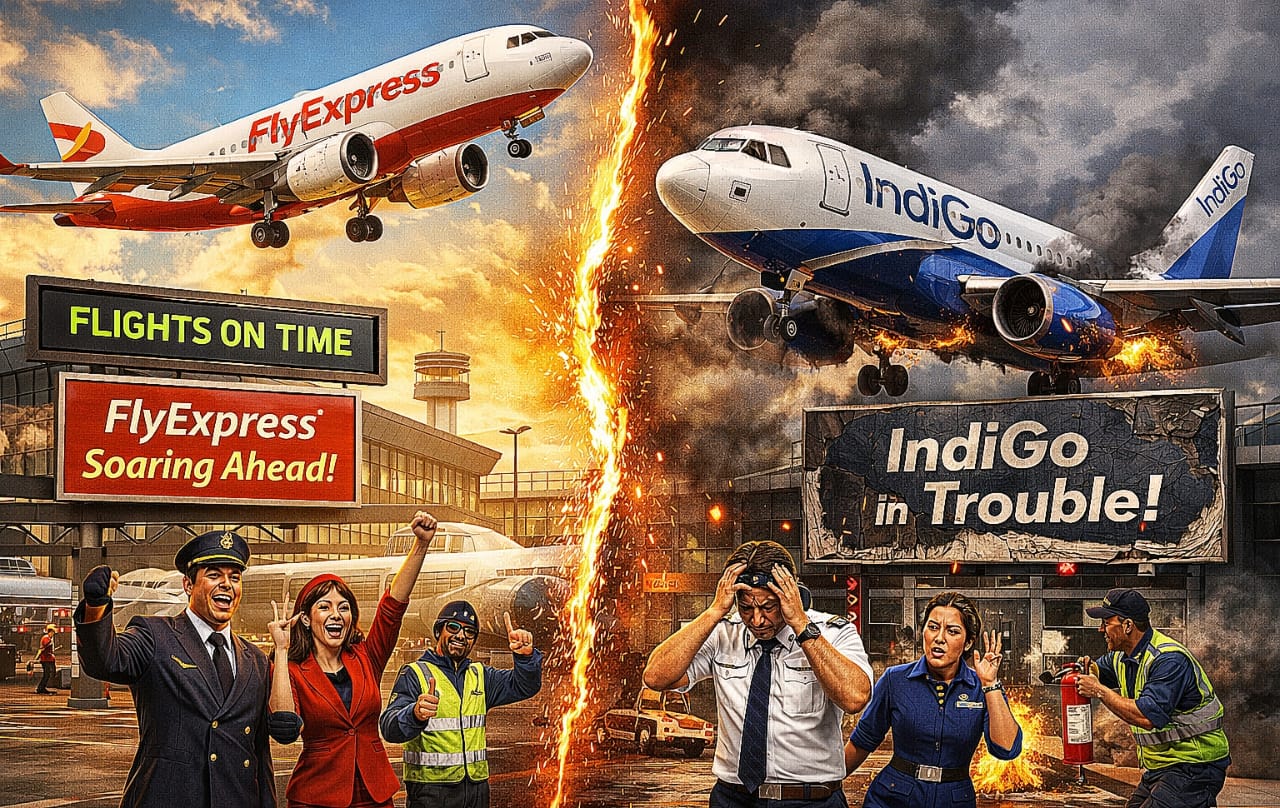
FlyExpress After IndiGo Crisis
India’s aviation sector has been one of the fastest-growing in the world, but late 2025 exposed a critical weakness in that growth story. A wave of operational disruptions at IndiGo—the country’s largest airline—triggered widespread delays, cancellations, fare spikes, and passenger frustration across multiple cities.
What followed was not just a news cycle, but a policy and market awakening.
Within days, the Indian government cleared No Objection Certificates (NOCs) for FlyExpress and Al Hind Air, while reaffirming approval for Shankh Air. The timing was crucial. Suddenly, FlyExpress after IndiGo crisis became more than an aviation headline—it became a symbol of correction.
This is why many industry observers believe FlyExpress is seen as a new airline after IndiGo crisis, not merely because it is new, but because it represents balance, competition, and reduced dependency in a concentrated market.
This article explores:
- What the IndiGo crisis revealed ?
- Why FlyExpress matters at this moment ?
- How FlyExpress compares with IndiGo ?
- What passengers and the industry can expect next ?
The IndiGo Crisis Explained: Scale Turned Into Vulnerability
IndiGo operates more than 65% of India’s domestic flights. Along with the Air India Group, the combined market share exceeds 90%. While such dominance brings operational efficiency, it also creates single-point failure risk.
What Went Wrong ?
The disruptions were not caused by a single failure but by overlapping pressures:
- Aircraft groundings due to global engine supply issues
- Crew shortages amid aggressive scheduling
- Weather-related delays cascading across hubs
- Limited spare aircraft to absorb shocks
Because of IndiGo’s scale, even small disruptions rippled nationwide.
Why the IndiGo Crisis Alarmed Regulators and Consumers ?
When IndiGo struggled, alternatives were limited.
Immediate Market Impact –
- Sudden fare hikes on remaining carriers
- Overbooking and capacity strain at airports
- Passengers stranded with few rebooking options
- Public debate over airline monopoly risks
The episode exposed a hard truth: India’s aviation system was too dependent on one airline.
Government Response: Fast-Tracking Competition
Recognizing the risk, the Ministry of Civil Aviation moved quickly to widen participation. 3 New Domestic Airlines Set to Take Off in 2026.
Newly Approved Domestic Airlines (2025) –
| Airline | NOC Status | Promoter Region | Expected Launch |
|---|---|---|---|
| Shankh Air | Approved earlier | Uttar Pradesh | 2026 |
| Al Hind Air | Approved Dec 2025 | Kerala | 2026 |
| FlyExpress | Approved Dec 2025 | Pan-India | 2026 |
Civil Aviation Minister K. Rammohan Naidu described the approvals as part of a broader effort to sustain growth while reducing market concentration.
This is where FlyExpress after IndiGo crisis became a strategic talking point.
FlyExpress After IndiGo Crisis: Why Timing Changed Everything ?
1. Approval During Peak Market Anxiety –
FlyExpress did not emerge in a calm environment. It entered the picture at the exact moment when confidence in market balance was shaken.
That timing reshaped perception.
FlyExpress was no longer viewed as:
- Just another startup airline
Instead, it became:
- A corrective signal
- A diversification tool
- A reassurance to passengers and policymakers
2. A Market Ready for Alternatives –
Passenger expectations had changed overnight. Reliability and choice suddenly mattered more than loyalty.
In that climate, FlyExpress after IndiGo crisis gained relevance before operating a single flight.
Why FlyExpress Is Seen as a New Airline After IndiGo Crisis ?
The phrase Why FlyExpress Is Seen as a New Airline After IndiGo Crisis reflects three underlying factors:
- The crisis revealed structural concentration,
- Policy action followed immediately,
- FlyExpress emerged as the most visible response.
Together, these elements elevated FlyExpress from a routine approval to a symbol of market correction.
FlyExpress New Airline: What Is Known So Far ?
Although FlyExpress is still in its pre-launch phase, industry analysts expect a measured and disciplined operating model.
Expected Features of FlyExpress –
- Domestic scheduled carrier
- Single-type aircraft fleet
- Cost-efficient operations
- Gradual, route-by-route expansion
This model contrasts with past airlines that expanded too fast without financial resilience.
FlyExpress vs IndiGo: Not a Rivalry, but a Rebalance
| Aspect | IndiGo | FlyExpress (Expected) |
|---|---|---|
| Market Share | ~65% | New entrant |
| Fleet Size | 350+ aircraft | Small, phased |
| Route Strategy | Metro-heavy | Regional + selective |
| Pricing Power | Dominant | Competitive |
| Growth Model | Ultra-scale | Controlled |
| Crisis Impact | System-wide | Localized |
The FlyExpress vs IndiGo discussion is not about replacing IndiGo. It is about reducing dependency on a single carrier.
Fly India Express vs Other New Airlines: Who Will Win India’s Aviation Race?
Market Concentration Visualized:
Approximate Domestic Market Share –
IndiGo          ██████████████████████████████ 65%
Air India Group ████████████████████           25%
Other Airlines  ████                           10%
Such concentration means any disruption can affect millions.
Why New Airlines Like FlyExpress Are Essential ?
Benefits of Increased Competition –
- Stabilized fares during disruptions
- Improved service accountability
- More route choices
- Reduced systemic risk
Even a limited-scale airline can influence behavior across the market.
The UDAN Factor: Regional Growth Opportunity
India’s UDAN (Ude Desh ka Aam Nagrik) scheme has already demonstrated how smaller airlines can succeed by serving underserved routes.
How FlyExpress May Leverage UDAN ?
- Flying to tier-2 and tier-3 cities
- Operating from less congested airports
- Building point-to-point connectivity
This approach aligns perfectly with FlyExpress’s expected scale.
Tier-2 and Tier-3 Cities That Could Benefit:
Likely Beneficiaries –
- Kanpur
- Gorakhpur
- Silchar
- Jharsuguda
- Hubballi
- Udaipur
- Tirupati
Improved air links can:
- Reduce travel time
- Boost local economies
- Encourage first-time flyers
Learning From Past Airline Failures:
India’s aviation history offers strong warnings.
Airlines That Collapsed –
- Kingfisher Airlines
- Jet Airways
- Go First
Common Failure Patterns –
| Cause | Outcome |
|---|---|
| High debt | Cash flow stress |
| Rapid expansion | Operational breakdown |
| Fuel exposure | Margin erosion |
| Weak governance | Loss of investor trust |
FlyExpress enters a more cautious regulatory environment shaped by these failures.
What FlyExpress Could Mean for Passengers ?
Expected Passenger Impact –
- Greater seat availability
- More stable peak-season fares
- Better service responsiveness
Even before launch, FlyExpress has influenced expectations.
Industry View: Why Analysts Are Watching FlyExpress ?
Aviation experts see FlyExpress as:
- A policy stress test
- A signal of regulatory learning
- A blueprint for future airline approvals
Its success or failure will influence how India licenses new carriers.
Frequently Asked Questions (Q&A):
Q1. Why is FlyExpress seen as a new airline after IndiGo crisis?
Because it was approved immediately after IndiGo’s disruptions exposed risks of market dominance, positioning it as a corrective entrant.
Q2. Is FlyExpress meant to compete directly with IndiGo?
No. FlyExpress is expected to focus on selective and regional routes rather than mass-market domination.
Q3. When will FlyExpress begin operations?
Commercial flights are expected in 2026, subject to final regulatory clearances and fleet induction.
Q4. How is FlyExpress different from Go First?
FlyExpress is expected to adopt phased growth, lower leverage, and tighter regulatory oversight.
Q5. Will FlyExpress lower ticket prices?
Competition historically stabilizes fares, especially during high-demand periods and disruptions.
The Bigger Picture: Indian Aviation at a Reset Point
India is on track to become the third-largest aviation market globally. Sustaining that growth requires:
- Multiple financially stable airlines
- Regional connectivity
- Reduced concentration risk
FlyExpress after IndiGo crisis fits squarely into this broader national strategy.
Conclusion: Why FlyExpress Matters Beyond Its First Flight ?
FlyExpress is not just another airline waiting to take off.
It represents:
- A response to crisis
- A policy correction
- A diversification strategy
Whether FlyExpress ultimately succeeds or struggles, its approval has already reshaped the narrative—cementing “FlyExpress After IndiGo Crisis: Why FlyExpress Is Seen as a New Airline After IndiGo Crisis” as one of the most important aviation stories of 2025–26.
About the Author