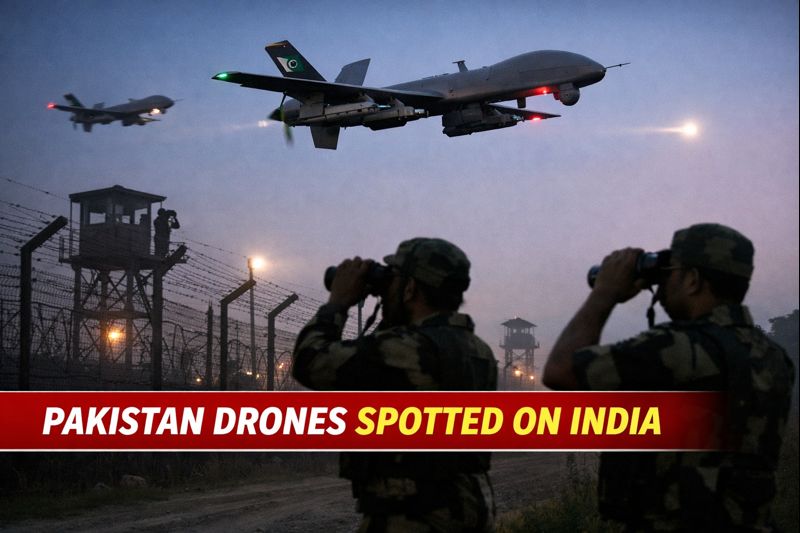
Pakistan Drones Spotted on India: LoC & IB Security Alert, Army Fires on Intruding Drones
The issue of Pakistan drones spotted on India has once again brought border security into sharp focus. On January 11–12, 2026, multiple suspected Pakistani drones were detected hovering over sensitive forward areas along the Line of Control (LoC) and the International Border (IB) in Jammu and Kashmir. The sightings across Samba, Rajouri, and Poonch districts triggered immediate military responses, including firing by Indian Army troops and extensive ground search operations.
These repeated incidents underline a growing pattern in what security experts describe as a new-age cross-border threat. From surveillance and reconnaissance to the delivery of arms, ammunition, and narcotics, drones have increasingly become a preferred tool for Pakistan-based elements. As concerns rise over a potential Pakistan drones attack on India, authorities remain on high alert to prevent infiltration, terror funding, and destabilisation of border regions.
Recent Drone Sightings Along the LoC and IB:
On Sunday evening, security forces detected at least five suspected drone movements in forward areas of Jammu and Kashmir. According to officials, all flying objects entered Indian airspace from the Pakistan side, hovered briefly, and then returned across the border.
Key Locations Where Drones Were Spotted –
- Samba district (IB) – Chak Babral village, Ramgarh sector
- Rajouri district (LoC) – Nowshera sector, Gania-Kalsian village, Khabbar village (Teryath area)
- Poonch district (LoC) – Mankote sector, movement from Tain towards Topa
Indian Army troops guarding the Nowshera sector reportedly fired medium and light machine guns after spotting drone movement. Similar sightings with blinking lights were reported from other sectors, prompting coordinated search operations involving the Army, police, and intelligence agencies.
Why Pakistan Drones Spotted on India Is a Serious Concern?
The repeated spotting of drones is not an isolated phenomenon. Over the past few years, drones have emerged as a low-cost, high-impact asymmetric warfare tool.
Key Threats Posed by Drone Incursions –
- Arms and Ammunition Drops – Drones are frequently used to drop pistols, grenades, magazines, and ammunition near the border.
- Narco-Terrorism – Drones facilitate the smuggling of drugs, which funds terror activities.
- Surveillance and Reconnaissance – Gathering intelligence on troop movements and infrastructure.
- Psychological Impact – Creating fear and uncertainty among border residents.
Just days before the latest sightings, security forces recovered an arms consignment in Samba district, allegedly dropped by a Pakistani drone. This included pistols, magazines, live rounds, and a grenade—reinforcing concerns of a planned Pakistan drones attack on India through proxy means.
Pattern of Drone Incursions: A Timeline
Below is a simplified table highlighting the recurring pattern of drone-related incidents along the India–Pakistan border:
| Year | Reported Drone Incidents | Key Purpose Identified |
|---|---|---|
| 2022 | Moderate | Surveillance, drug drops |
| 2023 | High | Arms delivery, reconnaissance |
| 2024 | Very High | Narco-terrorism, weapons supply |
| 2025 | Reduced (post-operations) | Limited surveillance |
| 2026 | Rising again | Arms drops, probing defenses |
This pattern shows that while operations such as Operation Sindoor temporarily reduced drone activity, incursions have resumed with renewed intensity.
Pakistan Drones Attack on India: Strategy Behind the Tactic
Security analysts believe Pakistan’s drone strategy is driven by multiple factors:
- Plausible Deniability – Small drones are hard to trace conclusively.
- Low Risk, High Reward – Drones avoid direct troop engagement.
- Technology Accessibility – Commercial drones modified for long-range use.
Unlike traditional infiltration attempts, drones do not require human couriers to cross borders, reducing risk for handlers while maintaining operational impact.
Comparison: Traditional Infiltration vs Drone-Based Infiltration
| Aspect | Traditional Infiltration | Drone-Based Infiltration |
|---|---|---|
| Risk to Operatives | Very High | Minimal |
| Detection | Moderate | Difficult at night |
| Payload Capacity | Limited | Moderate but effective |
| Cost | High | Relatively Low |
| Frequency | Limited | High and repeatable |
This comparison explains why drones have become central to Pakistan’s cross-border strategy.
Indian Army’s Response and Counter-Drone Measures:
India has significantly upgraded its counter-drone capabilities in recent years.
Key Measures in Place –
- Quick Reaction Teams (QRTs) along the LoC and IB
- Small Arms and Machine Gun Fire to neutralise low-flying drones
- Electronic Jamming Systems to disrupt drone signals
- Radar and Night-Vision Surveillance
- Joint Operations involving Army, BSF, police, and intelligence agencies
Following the latest sightings, standard operating procedures were immediately activated, and search operations continued late into the night to rule out any weapon or contraband drops.
Graph: Rise in Drone Sightings Over the Years
Drone Sightings (Approximate Trend)

2022 | ████
2023 | ████████
2024 | ████████████
2025 | █████
2026 | ██████████
The trend indicates a renewed spike in drone activity in 2026 after a temporary decline.
Impact on Civilians in Border Areas:
For residents of border villages, the sight of drones and sounds of gunfire are deeply unsettling. Night-time drone sightings disrupt daily life and create constant anxiety.
Civilian Concerns Include:
- Safety of homes and livestock
- Risk of accidental explosions from dropped weapons
- Fear of increased militant activity
Authorities have urged civilians to immediately report any suspicious objects and avoid touching unknown packages.
National Security Implications:
The continued spotting of Pakistan drones on India highlights a broader national security challenge. Drones blur the line between peace and conflict, operating below the threshold of full-scale war.
Key implications include:
- Increased vigilance along borders
- Greater investment in indigenous counter-drone technology
- Stronger diplomatic messaging against state-sponsored proxy tactics
Frequently Asked Questions (Q&A):
Q1: Why are Pakistan drones spotted on India frequently?
Pakistan drones spotted on India frequently, because Drones offer a low-risk method to deliver weapons, drugs, and gather intelligence without direct confrontation.
Q2: Are these drones armed?
Some Pakistan drones spotted on India are used for surveillance, while others have been confirmed to carry arms, ammunition, or narcotics.
Q3: How does India counter drone threats?
India uses a mix of firing, jamming, radar detection, and coordinated ground searches.
Q4: Is this a sign of escalation?
While not open warfare, repeated incursions indicate sustained proxy tactics and require constant vigilance.
Q5: What should civilians do if they spot a drone or object?
They should immediately inform security forces and avoid approaching or touching any suspicious items.
Conclusion:
The repeated incidents of Pakistan drones spotted on India serve as a stark reminder of evolving security challenges along the LoC and IB. While traditional infiltration methods have declined, drone-based tactics have emerged as a persistent and adaptable threat.
India’s swift military response, improved surveillance, and coordinated security measures have so far prevented major damage. However, the renewed surge in sightings in 2026 suggests that the threat of a Pakistan drones attack on India remains real and ongoing.
Continued vigilance, technological upgrades, and strong counter-measures will be crucial to safeguarding border regions and maintaining national security in the face of this modern challenge.
Keywords: pakistan drones spotted on india, pakistan drones attack on india, LoC drone sightings, IB drone threat, Jammu Kashmir drone alert
Umair Viral Video Pakistan Full Video Download: Behind the 7 Minutes 11 Seconds MMS
About the Author