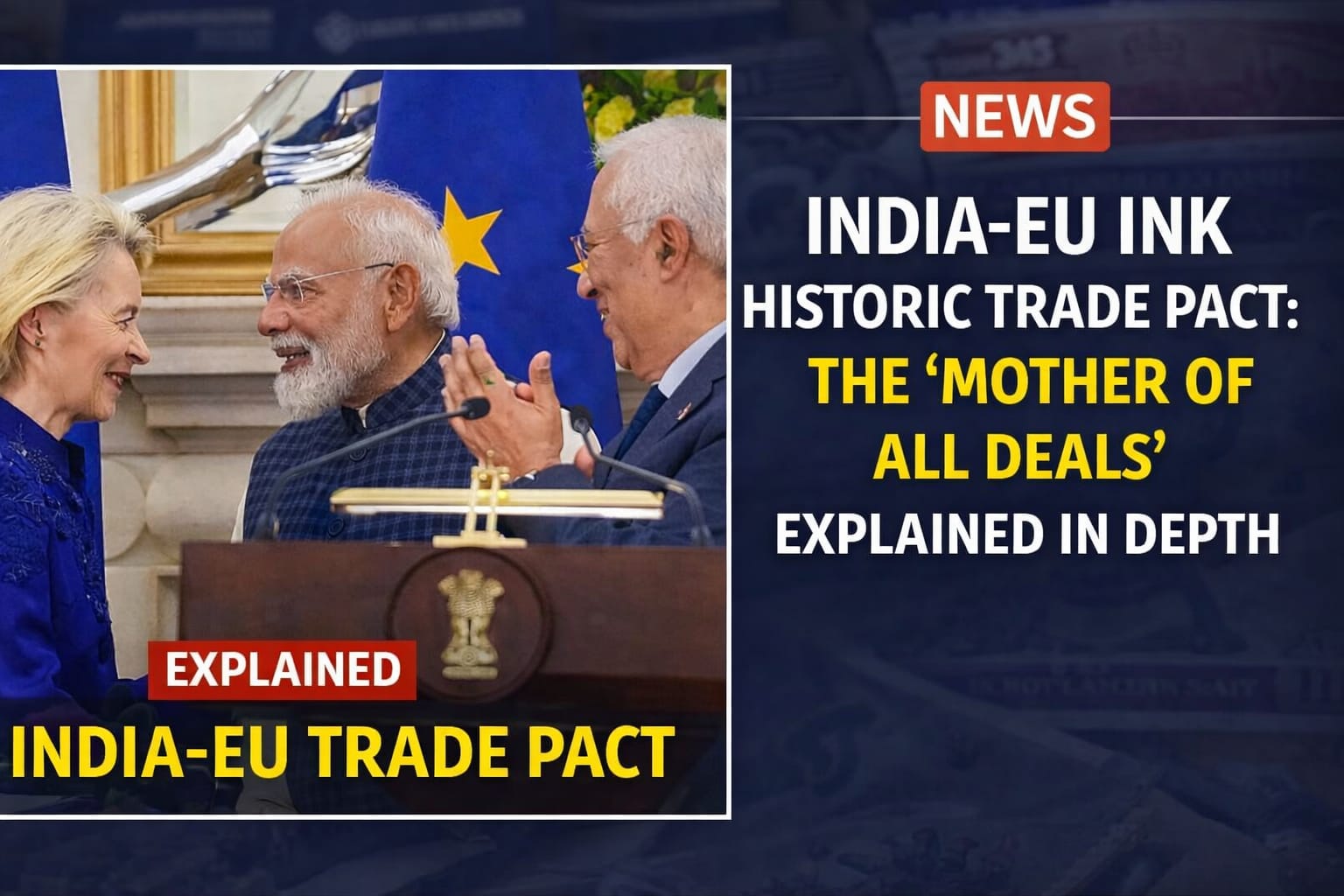
India-EU Ink Historic Trade Pact: The “Mother of All Deals” Explained in Depth
India and the European Union have concluded negotiations on one of the most ambitious trade agreements of the 21st century. After nearly 18 years of discussions, both sides formally announced the conclusion of their Free Trade Agreement (FTA) in January 2026, marking a historic shift in economic relations between two major global powers.
Often described as the Mother of all deals, the agreement links India’s scale, workforce and manufacturing ambitions with Europe’s technology, capital and innovation strength. Together, India and the EU account for nearly one-fourth of global GDP and around one-third of world trade, giving the pact enormous economic weight.
Table of Contents:
What Makes “India-EU Ink Historic Trade”?
The India-EU FTA is historic not only because of its size but also because of its depth and balance. Unlike limited trade arrangements, this agreement covers:
- Trade in goods
- Trade in services
- Investment protection
- Professional mobility
- Sustainable development
Crucially, it balances market access with protection for sensitive sectors, ensuring domestic industries are not exposed to sudden shocks.
Key Statistics at a Glance:
| Metric | India’s Access to EU | EU’s Access to India |
|---|---|---|
| Tariff Lines Covered | 97% | 92.1% |
| Trade Value Covered | 99.5% of Indian exports | 97.5% of EU exports |
| Immediate Duty Elimination | 70.4% of tariff lines | 49.6% of tariff lines |
| Phased Liberalization | 20.3% over 3-5 years | 39.5% over 5-10 years |
| Excluded/Sensitive Sectors | Limited agricultural products | Dairy, cereals, poultry, select fruits/vegetables |
Why Is the India–EU Trade Agreement Called the “Mother of All Deals”?
The India–EU Free Trade Agreement (FTA) has earned the title “Mother of all deals” because of its unprecedented scale, economic depth, strategic importance, and long-term global impact. No previous trade agreement involving India — or even many signed by the European Union — matches its size, complexity, and ambition.
Here are the key reasons behind this powerful label:
1. Massive Economic Scale
The agreement links two of the world’s largest economic blocs:
- 🇮🇳 India – 5th largest economy
- 🇪🇺 European Union – 3rd largest economy
Together, they account for:
- ~25% of global GDP
- ~30% of global trade
- Nearly 2 billion consumers
This makes it one of the largest bilateral trade agreements ever negotiated globally — hence the title Mother of all deals.
2. Record-Breaking Market Access
The FTA provides:
- 97% tariff line access for Indian exports to the EU
- 92.1% tariff line access for EU exports to India
By value, it covers:
- 99.5% of Indian exports
- 97.5% of EU exports
No previous Indian trade agreement offers such wide and deep market access.
3. Covers Goods, Services & Investment — Not Just Trade
Unlike many FTAs that focus only on goods, this deal includes:
- Trade in services
- Investment protection
- Professional mobility
- Digital trade & data flows
- Sustainable development commitments
This comprehensive scope makes it far more impactful than traditional trade pacts.
4. Ends an 18-Year Negotiation Marathon
Talks began in 2007, stalled in 2013, and resumed in 2021 — finally concluding in 2026.
An 18-year negotiation cycle is extremely rare in global trade diplomacy, highlighting:
- Complex interests
- Tough political compromises
- High economic stakes
This long journey adds to the deal’s historic stature.
5. Transformational Impact on Indian Industry
The agreement is expected to:
- Boost textiles, leather, gems, jewellery, marine exports
- Strengthen MSMEs
- Generate millions of jobs
- Integrate India into European supply chains
- Attract large-scale European investment
Few agreements promise such wide structural transformation of an economy.
6. Strategic Geopolitical Importance
Beyond economics, the deal reshapes global supply chains, helping both sides:
- Reduce overdependence on China-centric manufacturing
- Build trusted, diversified production networks
- Strengthen India–EU strategic partnership
This makes the pact geopolitically crucial, not just commercially important.
7. Biggest Trade Deal Ever Signed by India
In terms of:
- Market size
- Coverage
- Strategic depth
- Long-term impact
This is India’s largest and most ambitious trade agreement in history, surpassing deals with UAE, Australia, Japan, and ASEAN.
Sector-Wise Breakdown of Tariff Reductions:
Textiles & Apparel: A Major Boost for MSMEs –
The FTA eliminates all EU tariffs on textiles and apparel, removing duties of up to 12%. This opens the EU’s textile import market worth approximately $263.5 billion to Indian yarn, garments, and home textiles. The move is expected to significantly benefit employment-heavy MSME clusters across India, creating substantial job opportunities in one of India’s traditional strongholds.
Leather & Footwear: Enhanced Competitiveness –
EU duties of up to 17% will be eliminated immediately upon the FTA’s implementation. This sector, with current exports of $2.4 billion to the EU, stands to gain considerable market share in the EU’s $100 billion import market for leather and footwear products.
Marine Products: Coastal Economies to Benefit –
100% of trade value in marine products will see tariffs eliminated, with current duties as high as 26% reduced to zero. This will significantly enhance exports of shrimp, frozen fish, and value-added seafood, providing a substantial boost to India’s coastal economies and fishing communities.
Gems & Jewellery: Preferential Access Granted –
Import duties of up to 4% will be eliminated across all tariff lines, improving the competitiveness of India’s $2.7 billion jewellery exports in the EU’s massive $79.2 billion import market for gems and jewellery.
Engineering Goods: Access to $2 Trillion Market –
Tariffs of up to 22% on engineering exports will be reduced or eliminated, enhancing India’s competitiveness in the EU where engineering goods imports are valued at nearly $2 trillion. This sector represents one of the most significant opportunities for Indian manufacturers.
Chemicals, Plastics & Rubber –
The FTA provides zero duty access on 97.5% of India’s chemical export basket by value, removing tariffs of up to 12.8%. Similarly, preferential access to the EU market will reduce existing duties on plastics and rubber exports, supporting growth in India’s $2.4 billion exports to the EU against a global import market exceeding $317 billion.
Medical Devices & Instruments –
Tariffs of up to 6.7% will be eliminated across 99.1% of tariff lines, aiding exports of medical instruments, lenses, spectacles, and testing equipment. This comes at a time when global healthcare supply chains are being reevaluated, positioning India as a reliable partner for medical manufacturing.
Agricultural & Processed Food Products –
Preferential access has been secured for tea, coffee, spices, grapes, gherkins, cucumbers, dried onion, and selected fruits and vegetables. Sensitive sectors such as dairy, cereals, poultry, soymeal, and certain fruits and vegetables have been excluded to protect domestic interests, demonstrating the agreement’s balanced approach.
European Goods Entering Indian Markets:
Alcoholic Beverages: Significant Price Reductions –
One of the most noticeable impacts for Indian consumers will be the reduced prices of European alcoholic beverages:
| Product Category | Current Duty | Post-FTA Duty | Reduction |
|---|---|---|---|
| Premium Wines | Up to 150% | 20% | 130 percentage points |
| Medium-Range Wines | Up to 150% | 30% | 120 percentage points |
| Spirits (Whisky, Vodka, etc.) | Up to 150% | 40% | 110 percentage points |
| Beer | 110% | 50% | 60 percentage points |
Notable European brands that will become more affordable:
- Wines: Château Pétrus (France), Vega Sicilia Único (Spain), Champagne varieties
- Whiskey: Jameson, Bushmills (Ireland), Mackmyra (Sweden)
- Vodka: Absolut (Sweden), Grey Goose (France), Belvedere (Poland)
- Beer: Hoegaarden (Belgium), Stella Artois (Belgium), Heineken (Netherlands)
Industrial and High-Technology Products –
Nearly half of EU tariff lines (49.6%) will see immediate elimination of customs duties, covering:
- Machinery and mechanical equipment
- Electrical equipment
- Select chemicals and pharmaceuticals
- Medical devices
- Engineering goods
These imports are expected to lower input costs for Indian manufacturers, improve access to advanced technologies, and support India’s integration into global value chains.
Automobiles and Auto Components –
A significant portion of tariff lines (39.5%) will be subject to phased duty elimination over five, seven, and ten years. This staggered approach applies to more sensitive industrial products, including:
- Automobiles and auto components
- Capital goods
- Advanced manufacturing equipment
- Metals and certain consumer durables
The longer timelines are designed to give Indian industry sufficient time to adjust and enhance competitiveness while still committing to eventual tariff liberalization.
Agricultural Products with Safeguards –
For approximately 3% of tariff lines, India has agreed to partial tariff reductions rather than full duty elimination. These largely relate to agricultural and horticultural items such as:
- Apples and pears
- Peaches and kiwi fruit
- Other select fruits
In some cases, access for EU goods will be governed through tariff rate quotas (TRQs), allowing lower duties only up to a specified import volume to prevent market disruption.
Strategic and Economic Implications:
Bilateral Trade Enhancement –
India’s bilateral trade in goods with the EU stood at $136.53 billion in 2024–25, with exports of $75.85 billion and imports of $60.68 billion, making the EU India’s largest goods trading partner. Services trade reached $83.10 billion, with India posting a trade surplus of $15.17 billion.
The FTA is expected to significantly boost these numbers, with the European Union estimating annual duty savings of up to €4 billion for EU exporters alone.
Strategic Partnership in a Multipolar World –
European Commission President Ursula von der Leyen emphasized the strategic dimension of the agreement, stating it would combine “Indian skills and scale with Europe’s technology, capital and innovation.” She added, “It will create levels of growth that neither side can achieve alone, and by combining these strengths, we reduce strategic dependencies.”
Prime Minister Narendra Modi highlighted that the agreement would “unlock new opportunities for India’s 1.4 billion people and millions across Europe,” positioning both economies for resilient growth amid global economic uncertainty.
MSME and Employment Focus –
The agreement specifically benefits labor-intensive sectors dominated by Micro, Small, and Medium Enterprises (MSMEs), including:
- Textiles and apparel
- Leather and footwear
- Gems and jewellery
- Handicrafts and furniture
This focus aligns with India’s domestic economic priorities of job creation and support for small businesses, ensuring that trade liberalization contributes to inclusive growth.
Timeline and Negotiation Journey:
18-Year Path to Agreement –
The India-EU FTA negotiations represent one of the longest-running trade talks in modern history:
| Year | Milestone |
|---|---|
| 2007 | Negotiations officially launched |
| 2013 | Talks suspended due to disagreements on key issues |
| 2021 | Negotiations resumed with renewed political will |
| 2022-2025 | Intensive rounds of negotiations covering goods, services, and investment |
| January 2026 | Agreement formally concluded and announced |
Key Breakthrough Moments –
The final agreement was reached after several critical compromises:
- EU concessions on data security status and professional mobility
- Indian flexibility on alcoholic beverages and automotive sectors
- Mutual understanding on agricultural sensitivities and protections
- Balanced approach to intellectual property rights
Comparative Analysis with Other FTAs
India-EU FTA vs. Other Indian Trade Agreements –
| Parameter | India-EU FTA | India-UAE FTA | India-Australia ECTA |
|---|---|---|---|
| Coverage of Partner’s Exports | 97.5% (by value) | 90% | 85% |
| Immediate Duty Elimination | 49.6% of tariff lines | 65% | 70% |
| Phased Liberalization Period | Up to 10 years | Up to 10 years | Up to 7 years |
| Services Inclusion | Comprehensive | Limited | Moderate |
| Strategic Dimension | High (diversification from China) | Medium (energy security) | Medium (critical minerals) |
Unique Features of the India-EU Agreement –
- Unprecedented Scale: Covers the largest trade volume of any Indian FTA
- Balanced Approach: Significant concessions from both sides without compromising core interests
- Strategic Alignment: Explicit focus on reducing dependencies and building resilient supply chains
- Development Focus: Special attention to MSMEs and employment-intensive sectors
Frequently Asked Questions:
Q1: When will the India-EU FTA come into effect?
A: While negotiations concluded in January 2026, the agreement will enter into force after legal scrubbing, translation into all EU languages, and ratification by both parties. This process typically takes 12-24 months.
Q2: How will this agreement benefit Indian consumers?
A: Indian consumers will benefit from reduced prices on European goods, particularly:
- Premium wines and spirits
- High-quality consumer goods
- Advanced medical devices
- Luxury automobiles (over time)
- Specialized food products
Q3: What protections are in place for Indian farmers?
A: The agreement excludes several sensitive agricultural products from tariff reductions, including dairy, cereals, poultry, soymeal, and certain fruits and vegetables. For some products, tariff rate quotas allow limited imports at lower duties while protecting domestic markets.
Q4: How does this agreement impact India’s ‘Make in India’ initiative?
A: The FTA supports ‘Make in India’ by:
- Providing cheaper access to European machinery and technology
- Enhancing export opportunities for Indian manufacturers
- Encouraging European investment in Indian manufacturing
- Facilitating integration into global value chains
Q5: What are the environmental and labor standards in the agreement?
A: While details are still emerging from the full text, EU FTAs typically include chapters on sustainable development covering environmental protection and labor rights. These are expected to be based on international standards while considering different development levels.
Q6: How will services trade be affected?
A: The agreement includes comprehensive services liberalization, with enhanced market access for:
- Indian IT and professional services
- EU financial and business services
- Cross-border data flows with safeguards
- Temporary movement of professionals
Conclusion: A New Era of Partnership
The India-EU “mother of all deals” represents a transformative moment in global trade relations. By combining India’s demographic dividend, growing manufacturing capabilities, and services expertise with Europe’s technological sophistication, capital resources, and innovation ecosystems, this agreement creates a partnership that transcends traditional trade metrics.
The historic India-EU trade pact is notable not just for its economic scale but for its strategic timing. As both economies seek to diversify supply chains and build resilience in an uncertain global landscape, this agreement provides a framework for deeper integration based on mutual respect and shared interests.
By protecting sensitive sectors while opening massive export opportunities, the agreement demonstrates that ambitious trade deals can remain pragmatic and people-centric. Over the coming decades, its true success will be measured not only in trade figures but in jobs created, technologies transferred, and livelihoods improved across both regions.
Sheikh Hasina Delhi Address Leaves Bangladesh Shocked: Political Fallout and Regional Implications
About the Author