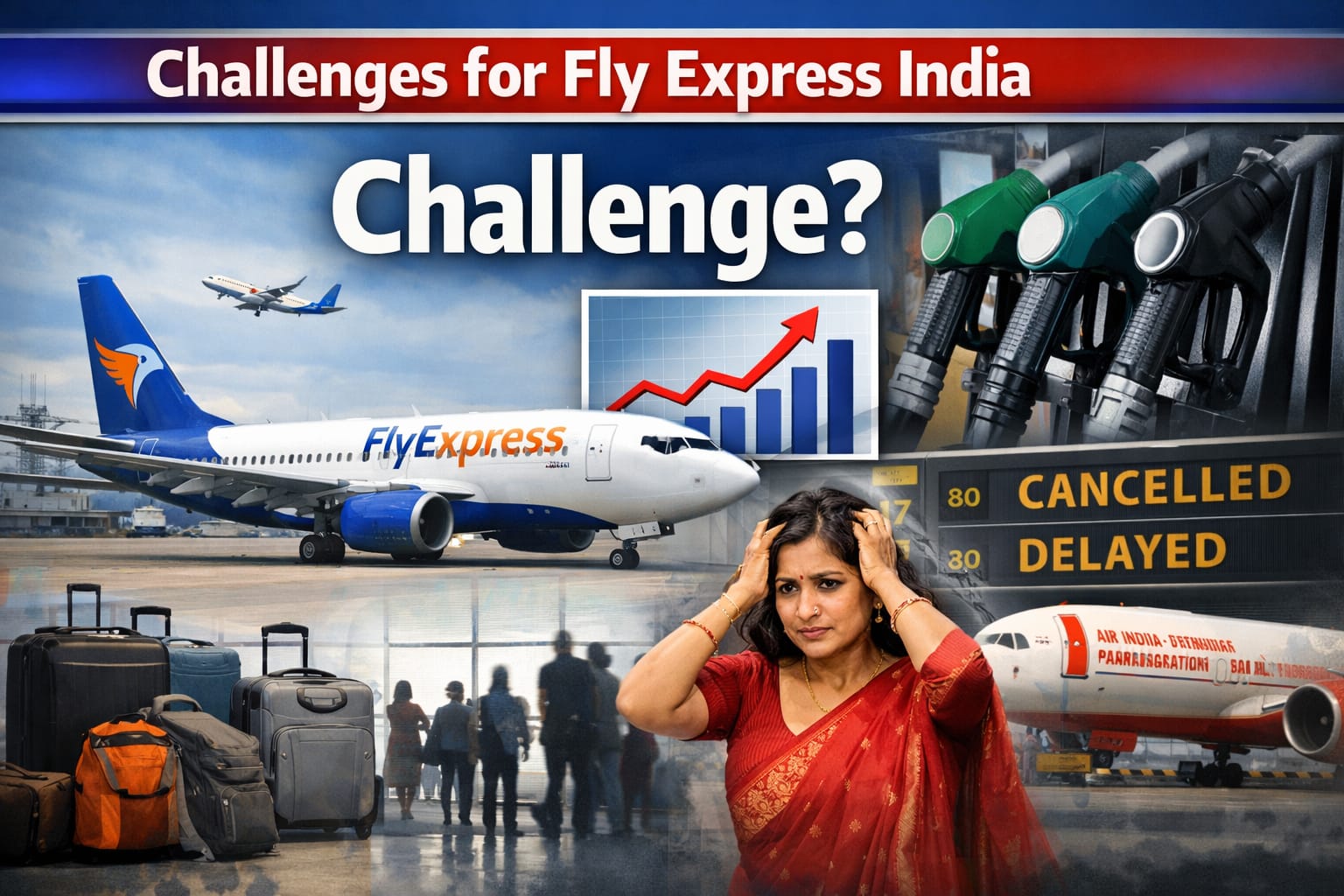
key challenges for Fly Express Airlines India
Why “Challenges for Fly Express Airlines India” Matter ?
India’s aviation market is expanding faster than almost any other in the world. Rising middle-class incomes, regional connectivity, and government-backed airport expansion have made flying more accessible than ever. Into this competitive sky enters Fly Express Airlines India, a new player aiming to attract budget-conscious travelers.
But launching an airline in India is not just about low fares and new aircraft. History shows that many Indian airlines failed not because of lack of demand—but because of structural, financial, and operational challenges.
This article explores the key challenges for Fly Express Airlines India, breaking down regulatory hurdles, pricing pressures, operational risks, and market realities. Whether you are an aviation enthusiast, investor, or frequent flyer, this deep dive explains what Fly Express must overcome to survive and succeed.
The Indian Aviation Landscape: Opportunity Meets Pressure –
Before examining the challenges for Fly Express Airlines India, it’s important to understand the market it is entering.
Snapshot of Indian Aviation –
| Factor | Current Reality |
|---|---|
| Market Size | One of the world’s fastest growing |
| Passenger Type | Highly price-sensitive |
| Dominant Players | IndiGo, Air India Group |
| Cost Pressure | High fuel & airport charges |
| Competition | Aggressive fare wars |
India offers huge demand, but razor-thin margins. This combination makes airline survival difficult—even for experienced operators.
Challenge 1: Intense Competition From Established Airlines
A Market Dominated by Giants –
One of the biggest challenges for Fly Express Airlines India is entering a market already dominated by powerful incumbents.
- IndiGo controls a majority share of domestic traffic
- Air India Group operates multiple brands
- Akasa Air and Air India Express focus on budget segments
Why This Is a Problem ?
Established airlines benefit from:
- Economies of scale
- Larger fleets
- Better airport slots
- Strong brand trust
Fly Express must compete not only on price, but also on reliability and perception—without the benefit of scale.
Challenge 2: Price Wars and Ultra-Thin Margins –
The Fare Trap –
India is known for brutal price competition. While low fares attract passengers, they also squeeze profitability.
Pricing Comparison Pressure –
| Airline Type | Average Margin |
|---|---|
| Full-Service | Low |
| Low-Cost Carrier | Very Low |
| Ultra-Low-Cost (ULCC) | Extremely Thin |
Fly Express is expected to follow a ULCC model, which increases exposure to margin risks.
Key Risk:
Sustained discounting can quickly turn into losses if fuel prices or demand fluctuate.
Challenge 3: High Aviation Turbine Fuel (ATF) Costs –
Fuel: The Biggest Cost Burden
Fuel accounts for 35–45% of airline operating costs in India—much higher than global averages.
Why ATF Is a Serious Challenge ?
- State-level taxes vary widely
- Limited hedging options
- Global oil price volatility
Even small increases in ATF prices can erase profits instantly, making fuel one of the most critical challenges for Fly Express Airlines India.
Challenge 4: Airport Charges and Slot Constraints –
Costly Airports, Limited Access:
Major Indian airports charge:
- High landing fees
- Expensive parking costs
- Premium slot charges during peak hours
Slot Availability Challenge:
| Airport | Slot Availability |
|---|---|
| Delhi | Extremely Limited |
| Mumbai | Highly Congested |
| Bengaluru | Competitive |
| Tier-2 Airports | Better, but lower yields |
Fly Express may be forced to:
- Operate at off-peak hours
- Use secondary airports
- Accept suboptimal schedules
All of which impact revenue potential.
Challenge 5: Building Passenger Trust as a New Brand –
Trust Takes Time:
For passengers, airlines are about safety, punctuality, and reliability.
As a new entrant, Fly Express faces:
- Low brand recognition
- Passenger skepticism
- Comparison with trusted incumbents
Passenger Decision Factors:
| Factor | Importance |
|---|---|
| Price | High |
| On-time performance | Very High |
| Safety perception | Critical |
| Customer support | High |
One operational mishap early on can damage brand confidence significantly.
Challenge 6: Operational Complexity and Reliability –
Airlines Are Operationally Fragile –
Even a small disruption can cause:
- Flight delays
- Crew misalignment
- Aircraft grounding
For Fly Express Airlines India, operational challenges include:
- Crew training and retention
- Aircraft maintenance scheduling
- Spare part availability
New airlines often struggle with scale-related operational stress, especially during rapid expansion.
Challenge 7: Pilot and Skilled Workforce Shortage –
India’s Aviation Talent Gap –
India faces a growing shortage of:
- Experienced pilots
- Aircraft maintenance engineers
- Trained cabin crew
Why This Is Risky ?
| Workforce Area | Risk Level |
|---|---|
| Pilots | Very High |
| Engineers | High |
| Ground Staff | Medium |
Higher salaries and training costs increase expenses, weakening Fly Express’s low-cost advantage.
Challenge 8: Regulatory and Compliance Burden –
Complex Aviation Regulations:
The Indian aviation sector is heavily regulated, covering:
- Safety audits
- Operational approvals
- Route permissions
- Fare transparency rules
Regulatory Challenges Include:
- Slow approval timelines
- Frequent compliance checks
- Policy uncertainty
For Fly Express Airlines India, regulatory delays could postpone expansion and affect investor confidence.
Challenge 9: Dependency on Ancillary Revenue –
The Add-On Revenue Risk:
Fly Express is expected to rely heavily on:
- Baggage fees
- Seat selection charges
- Onboard sales
Ancillary Revenue Breakdown (Illustrative):
Total Revenue Share
-------------------
Base Fare        ██████ 60%
Ancillaries      ████ 40%
If passengers resist add-ons or competitors bundle services cheaply, this revenue stream weakens.
Challenge 10: Economic Slowdowns and Demand Volatility –
Aviation Is Cyclical:
Air travel demand drops during:
- Economic downturns
- Health crises
- Geopolitical instability
Budget airlines are especially vulnerable because:
- Their customers are price-sensitive
- Discretionary travel drops quickly
This makes long-term stability a serious challenge for Fly Express Airlines India.
Comparison: Fly Express vs Past Indian Airline Failures –
| Factor | Failed Airlines | Fly Express |
|---|---|---|
| Entry Timing | Weak market cycles | Growing demand |
| Cost Control | Poor | Planned lean model |
| Fleet Strategy | Mixed | Single-type likely |
| Pricing Discipline | Aggressive | Yet to be tested |
Fly Express has advantages—but history shows that execution matters more than intent.
Graph: Risk Intensity by Challenge Area (Illustrative)
Risk Level

High     | Fuel ██████████
        | Competition █████████
Medium  | Regulation ██████
        | Workforce ██████
Low     | Demand ████
Frequently Asked Questions (Q&A):
Q1: What is the biggest challenge for Fly Express Airlines India?
Fuel costs and price competition are the most critical challenges for Fly Express Airlines India, as both directly affect profitability.
Q2: Can Fly Express survive in India’s competitive aviation market?
Yes, but only with strict cost discipline, smart route planning, and operational reliability.
Q3: Are new airlines at higher risk in India?
Historically, yes. India has seen several airline failures due to thin margins and high fixed costs.
Q4: Will government policies help Fly Express?
Supportive policies like regional connectivity help, but core cost issues remain unresolved.
Q5: Is the ULCC model risky in India?
It is high-risk, high-reward. Success depends on load factors, fuel efficiency, and ancillary revenue acceptance.
Strategic Opportunities Hidden Inside These Challenges:
While the challenges for Fly Express Airlines India are significant, they also create opportunities:
- Weak competitors can exit
- Demand continues to grow
- Tier-2 and Tier-3 cities remain underserved
- Technology can optimize costs
Airlines that survive early turbulence often emerge stronger.
Can Fly Express Overcome These Challenges?
Short Answer: It’s Possible, But Not Easy.
Fly Express Airlines India faces:
- Structural cost pressures
- Fierce competition
- High execution risk
But with:
- Disciplined expansion
- Realistic pricing
- Operational focus
…it can carve a sustainable niche in India’s aviation ecosystem.
Final Thoughts: Why These Challenges Matter to Passengers?
For travelers, understanding the challenges for Fly Express Airlines India explains:
- Why fares fluctuate
- Why add-ons exist
- Why punctuality matters so much
If Fly Express navigates these challenges well, Indian passengers could benefit from more choice, better prices, and stronger competition.
Fly India Express Airlines Owner: Who Is Behind India’s New Budget Airline?
About the Author