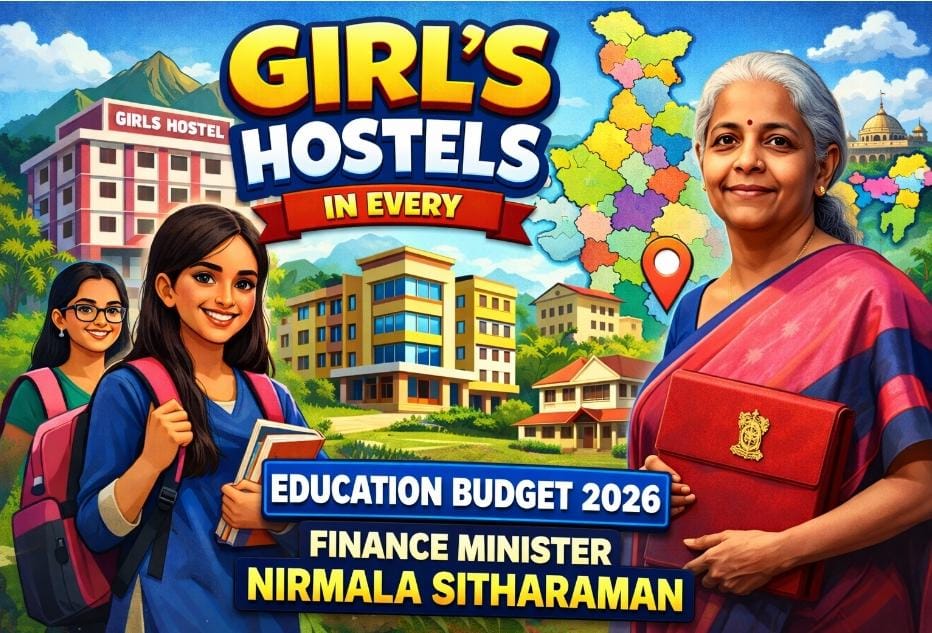
Girls’ Hostels in Every District: Education Budget 2026 Updates Spark Praise and Safety Debate
A Landmark Promise in Education Budget 2026 Updates
In a landmark announcement aimed at transforming female education and workforce participation, Union Finance Minister Nirmala Sitharaman has declared the government’s plan to construct Girls’ Hostels In Every District across India. The initiative, a cornerstone of the Education Budget 2026 Updates, is designed to dismantle one of the most persistent barriers to women’s advancement: the lack of safe, affordable, and accessible accommodation.
While political leaders across party lines welcomed the move, citizens, education experts, and women’s rights activists have raised critical questions around implementation timelines, security protocols, and hostel capacity. As expectations rise, the success of Girls’ Hostels In Every District will depend not only on intent but also on execution.
This in-depth report breaks down the announcement, reactions, concerns, comparisons, and what the Education Budget 2026 Updates truly signal for India’s girls and women.
Table of Contents:
What Was Announced in Education Budget 2026 Updates?
During her budget speech, Finance Minister Sitharaman stated:
“A girl’s hostel will be built in every district of the country to provide safe and accessible accommodation, supporting enrolment and retention in higher education, particularly in advanced scientific fields.”
Under the Education Budget 2026 Updates, the government has reportedly earmarked ₹10,000 crore, to be deployed over multiple years, for the rollout of Girls’ Hostels In Every District.
Key Highlights at a Glance –
| Feature | Details |
|---|---|
| Total districts covered | ~700 |
| Estimated budget | ₹10,000 crore |
| Target beneficiaries | Female students & working women |
| Priority areas | Low female enrolment districts |
| Implementation model | Centre–State partnership |
| Land use | Existing government land & public infrastructure |
Why Girls’ Hostels In Every District?
The Education Budget 2026 Updates come against the backdrop of persistent gender gaps in higher education and employment.
The Core Problem –
- Millions of girls drop out after Class XII
- Colleges are often far from villages
- Daily travel of 40–50 km is unsafe and expensive
- Private hostels are costly, discriminatory, or insecure
By proposing Girls’ Hostels In Every District, the government is attempting to remove one of the most structural barriers faced by women.
SHE Mart Schemes for Women Entrepreneurs Under Budget 2026: How and Who Can Apply?
Political Reactions: Rare Cross-Party Praise
One notable feature of the Education Budget 2026 Updates has been broad political support for the hostel announcement.
BJP’s Response –
BJP MP Medha Kulkarni welcomed the initiative, calling it:
“A highly impactful step for women’s development and safety, aligned with the vision of Viksit Bharat.”
AAP’s Qualified Support –
AAP spokesperson Mukund Kirdat praised the intent but warned:
“There are nearly 700 districts. Without a clear timeline, Girls’ Hostels In Every District risk remaining only a promise.”
Voices from the Ground: Hope Mixed With Skepticism
While the announcement under Education Budget 2026 Updates has generated optimism, citizens stress that safety and capacity must not be afterthoughts.
Safety as the Central Concern –
Women activists argue that hostels alone do not guarantee security.
Manjusha Kochar, a women’s rights activist, noted:
“Without clear intake capacity and security norms, one hostel per district may be insufficient to meet real demand.”
North-East residents also highlighted the need for culturally sensitive security mechanisms, including dedicated police helpdesks.
Girls’ Hostels In Every District: The Safety Question
A major critique of the Education Budget 2026 Updates is the absence of explicit safety guidelines in the budget speech.
What Citizens Are Demanding?
- 24×7 female security staff
- CCTV coverage & access control
- Panic buttons & helpline integration
- Local police coordination
- Digital visitor logs
Without these, critics argue that Girls’ Hostels In Every District risk replicating the shortcomings of existing government hostels.
Capacity Concerns: One Hostel Is Not Enough?
India’s population size poses a unique challenge.
The Numbers Problem –
- One district can have thousands of female students
- Migration for education is increasing
- STEM enrolment targets are rising
Experts argue that Education Budget 2026 Updates should clarify whether:
- Multiple hostels will be allowed per district
- Expansion clauses exist
- PPP (public-private partnerships) will be used
Comparison: India vs Global Models
| Country | Hostel Coverage | Safety Standards |
|---|---|---|
| India (Proposed) | 1 per district | Yet to be detailed |
| China | Campus-linked dorms | Strict access control |
| Germany | Student housing boards | Subsidised & regulated |
| South Korea | University townships | Integrated transport & security |
Compared to global peers, Girls’ Hostels In Every District is ambitious in scale but still vague in standards.
Comparative Analysis: How Does This Scheme Stack Up?
| Aspect | New ‘Hostels in Every District’ Scheme | Existing Hostel Schemes (e.g., MHRD) | Private PG/Hostel Market |
|---|---|---|---|
| Primary Goal | Universal access & safety | Supplement institutional capacity | Profit-driven accommodation |
| Pricing | Expected to be highly subsidized | Subsidized for enrolled students | Market rates, often high |
| Security Regulation | Proposed high standards (details awaited) | Varies by college/ university | Largely unregulated, inconsistent |
| Coverage | Pan-India, district-level | Attached to specific colleges/universities | Concentrated in urban, profitable areas |
| Challenge | Implementation scale & speed | Limited numbers, fierce competition | Safety concerns, affordability issues |
A Deeper Dive: The Potential Ripple Effects
On Education and Demographics –
- STEM Enrollment Boost: By providing secure housing, the scheme could directly increase the number of girls opting for and completing degrees in science, technology, engineering, and mathematics.
- Delaying Early Marriage: Access to higher education is a proven factor in delaying the age of marriage, leading to better health and economic outcomes.
- Balancing Regional Disparity: Students from educationally backward districts can pursue quality education in district headquarters without the prohibitive fear of unsafe lodging.
On the Economy and Workforce –
- Female Labor Force Participation (FLFP): India’s FLFP remains worryingly low. Safe hostels for working women can facilitate migration for better jobs, directly boosting economic participation.
- Skilling Pipeline: The hostels can be integrated with ITIs and skill development centers, creating a robust pipeline of trained women for the industrial and service sectors.
Officials believe Girls’ Hostels In Every District will create a multiplier effect across social and economic indicators.
Integration With Other Education Budget 2026 Updates
The hostel scheme does not exist in isolation.
Related Announcements –
- Five university townships near logistics hubs
- National Institute of Hospitality
- New AIIMS & Ayurveda institutes
- Skill-linked education reforms
Together, these Education Budget 2026 Updates aim to create an ecosystem where accommodation, education, and employment are connected.
Will Working Women Also Benefit?
Yes. According to officials, Girls’ Hostels In Every District will also be open to:
- Working women
- Skill trainees
- Early-career professionals
This marks a shift from earlier hostel schemes limited only to students.
Implementation Challenges Ahead
Despite the optimism around Education Budget 2026 Updates, several risks remain.
Key Challenges –
- Land acquisition delays
- Centre-State coordination gaps
- Maintenance & funding sustainability
- Safety enforcement
- Fair allotment mechanisms
Unless addressed early, these could undermine the promise of Girls’ Hostels In Every District.
FAQs: Girls’ Hostels In Every District
Q1: Who is eligible to stay in these new Girls’ Hostels In Every District?
A: While final guidelines are awaited, the scheme is primarily targeted at female students pursuing higher education or vocational training. It may also extend to working women migrating for employment. Specific eligibility criteria regarding age, income, and domicile will be defined by the implementing authorities.
Q2: What makes this announcement in the Education Budget 2026 Updates different from existing hostel facilities?
A: The scale and intent are unprecedented. Existing hostels are mostly attached to specific institutions. This scheme aims for district-wide coverage, ensuring availability regardless of the institution a student is enrolled in, thus filling a major gap in the ecosystem.
Q3: How will the government ensure the safety of residents?
A: This is the central challenge. Success will depend on the formulation and strict enforcement of a comprehensive security protocol, including infrastructure (lighting, fences, CCTV), personnel (trained female wardens, security), and processes (visitor management, night patrols, police liaison).
Q4: Is there a financial estimate for the scheme?
A: As per reports, the government has earmarked an outlay of approximately ₹10,000 crore to be spread over multiple years. The per-district cost will vary based on land, construction, and capacity.
Q5: How can students apply once these hostels are built?
A: It is expected that a centralized online portal or a state-managed application process will be developed. Details will be part of the detailed scheme guidelines released by the concerned ministry.
What Experts Recommend Going Forward?
To ensure success, experts suggest:
- Transparent timelines
- District-wise demand assessment
- Independent safety audits
- Student representation in management
- Digital monitoring dashboards
These steps could turn Girls’ Hostels In Every District into one of the most transformative outcomes of the Education Budget 2026 Updates.
Conclusion: Promise or Turning Point?
The announcement to build Girls’ Hostels In Every District is arguably one of the most socially transformative proposals in the recent Education Budget 2026 Updates. It correctly identifies a critical infrastructural deficit that hinders gender parity. The widespread praise it has received is a testament to its perceived necessity.
However, the cautious optimism voiced by activists and citizens serves as a crucial reminder. A hostel is more than a building; it is a safe home. The scheme’s legacy will be determined not by the cornerstone-laying ceremonies, but by the rigorous details of security, the fairness of its allocation, its ability to meet demand, and the speed of its rollout.
If implemented with transparency, inclusivity, and an unwavering commitment to safety, this initiative can indeed become a monumental pillar in India’s journey toward educational equity and women’s empowerment. The nation now watches, hopes, and awaits the detailed blueprint that will turn this visionary budget announcement into a tangible reality.
For now, India watches closely—hopeful, alert, and demanding accountability.
READ MORE:
- Mukhyamantri Ladli Behna Yojana Online Apply 2026: Eligibility, Benefits, Documents, Registration Process
- SHE Mart Schemes for Women Entrepreneurs Under Budget 2026: How and Who Can Apply?
- Divyang Kaushal Yojana 2026: A Transformative Blueprint for Skill-Led Empowerment
- Full List of New Govt Schemes 2026: Your Complete Guide to Budget Benefits, Eligibility, and Impact
About the Author
About the Author