
3kW Solar System Price for Home in India (2026) – Complete Cost Guide with Subsidy
With electricity tariffs rising steadily across India and frequent power cuts still troubling many regions, rooftop solar has shifted from a “nice-to-have” upgrade to a smart financial decision. Among all residential solar capacities, the 3kW solar system has emerged as the most popular choice for middle-class households.
Why? Because it perfectly balances price, power generation, roof space, and return on investment.
If you are planning to install solar this year, this guide will help you understand the 3kW solar system price for home in India in 2026, including subsidy benefits, system types, installation costs, savings, and long-term value—without technical confusion or sales jargon.
Table of Contents:
Why a 3kW Solar System Is Ideal for Indian Homes
A 3kW rooftop solar system is designed for small to medium-sized households with average electricity consumption. It generates enough power to significantly cut monthly electricity bills while remaining affordable even for first-time solar buyers.
Who Should Choose a 3kW System?
A 3kW solar system is ideal if:
- Your monthly electricity usage is 300–400 units
- Your bill ranges between ₹2,500 and ₹4,000
- You have 250–300 sq. ft. of shadow-free roof space
- Your family size is 3–4 members
Appliances a 3kW Solar System Can Run
- 6–8 LED lights
- 3–4 ceiling fans
- Refrigerator
- Washing machine (intermittent)
- LED TVs
- Mixer, laptop chargers, Wi-Fi router
Under Indian weather conditions, a 3kW system produces 12–15 units per day, which covers most daily household needs.
Profitable Solar Business Ideas in India: Best Opportunities to Make Money in 2026
3kW Solar System Price for Home in India (2026)
The 3kW solar system price for home varies depending on panel quality, inverter type, and system configuration (on-grid, off-grid, or hybrid).
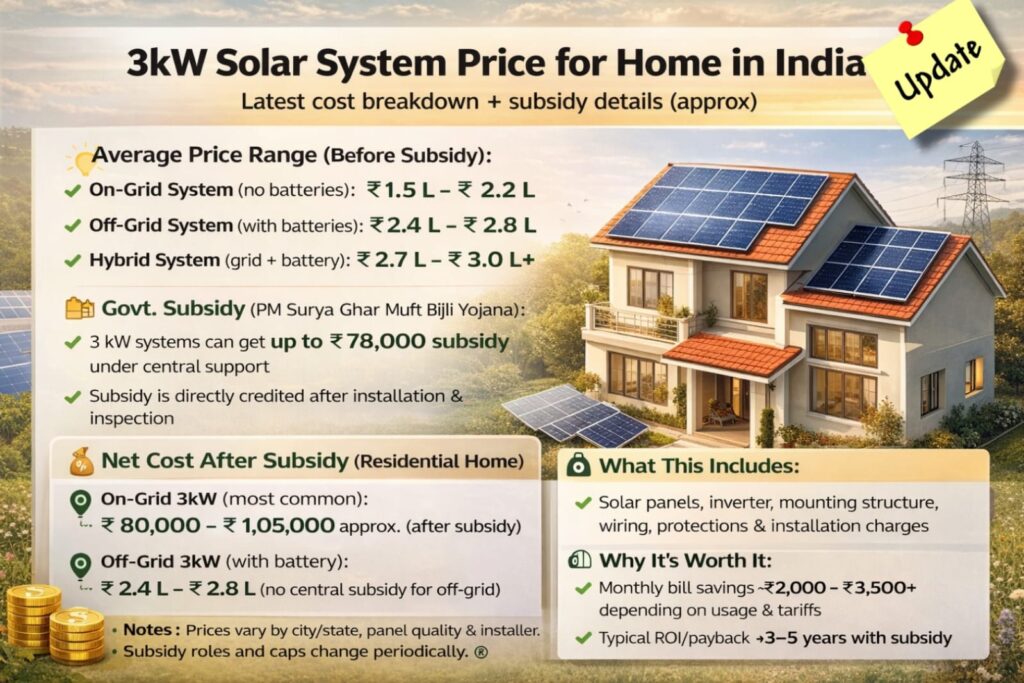
Average Price Range (Before Subsidy) –
| System Type | Price Range (₹) | Key Components Included |
|---|---|---|
| Basic On-Grid | ₹1,35,000 – ₹1,65,000 | Polycrystalline panels, basic inverter, structure, DC wires. |
| Premium On-Grid | ₹1,65,000 – ₹2,10,000 | Mono PERC panels, smart hybrid inverter, monitoring, sturdy structure. |
| Off-Grid with Battery | ₹2,50,000 – ₹3,50,000 | Solar panels, inverter, battery bank (lead-acid/Li-ion), charge controller. |
| Hybrid System | ₹2,20,000 – ₹3,00,000 | Panels, hybrid inverter, limited battery backup, grid connection. |
💡 Most urban households choose on-grid systems because they are cheaper and subsidy-eligible.
3kW Solar System Price Per Watt in India
Understanding per-watt pricing helps you compare installer quotes transparently.
- Economy systems: ₹45–₹55 per watt
- Standard systems: ₹55–₹65 per watt
- Premium systems: ₹65–₹70+ per watt
A quote of ₹60 per watt means:
3000W × ₹60 = ₹1,80,000 total system cost
3kW Solar System Price for Home With Government Subsidy
The Indian government offers generous financial support under the PM Surya Ghar: Muft Bijli Yojana, making solar far more affordable for homeowners.
Central Subsidy Structure (MNRE – 2026)
| Capacity | Subsidy Amount |
|---|---|
| First 2kW | ₹30,000 per kW |
| Additional 1kW | ₹18,000 |
| Total for 3kW | ₹78,000 |
Final Cost After Subsidy
If your system price is ₹1,80,000:
- System cost: ₹1,80,000
- Less subsidy: ₹78,000
- Final payable amount: ₹1,02,000
This is why the 3kW solar system price for home after subsidy often falls close to ₹1 lakh.
On-Grid vs Off-Grid vs Hybrid: Price Comparison
1. On-Grid 3kW Solar System –
The most popular and cost-effective option for homes with reliable grid power.
- Lowest cost
- Net metering allows exporting excess power
- No battery required
- Price: ₹1.35–₹2.10 lakh
- Subsidy: Yes
- How it works: Connects to the utility grid. Excess solar power is exported to the grid, earning you credits (net metering). You draw power from the grid at night or on cloudy days.
- Best for: Homes looking to reduce electricity bills with no power cuts.
2. Off-Grid 3kW Solar System (With Battery)
A complete independence solution, but at a higher cost.
- Complete independence from grid
- High battery cost
- No net metering
- Price: ₹2.50–₹3.50 lakh
- Subsidy: NoBattery Cost Breakup: A battery bank for 3kW can cost ₹80,000 to ₹1,50,000+ depending on technology (Lead-acid cheaper, Lithium-ion longer-lasting).
- Best for: Areas with frequent, long power cuts and no reliable grid.
3. Hybrid 3kW Solar System
The best of both worlds—saves money and provides backup.
- Grid + battery backup
- Partial power backup during outages
- Balanced solution
- Price: ₹2.20–₹3.00 lakh
- Subsidy: Yes (for on-grid portion)
- How it works: Uses a hybrid inverter to manage solar power, battery charging, and grid import/export. Provides limited backup during cuts.
- Best for: Homes with moderate power cuts looking to maximize self-consumption and savings.
Comparison Table: System Types
| Feature | On-Grid | Off-Grid | Hybrid |
|---|---|---|---|
| Upfront Cost | Lowest | Highest | Moderate-High |
| Grid Dependency | Yes | No | Yes |
| Power Backup | No | Yes | Yes (Limited) |
| Net Metering | Yes | No | Yes |
| Subsidy Eligible | Yes | No | Yes* |
| ROI Period | 3-5 years | 7-10 years | 5-7 years |
What Is Included in 3kW Solar System Installation Cost?
A genuine installer quote for 3kW solar system price for home with installation should include:
- Solar Panels (9-10 panels of 330-335W each)
- Inverter (3kW capacity)
- Mounting Structure (Galvanized Iron or Aluminium)
- DC & AC Cables, Connectors, Conduits
- Earthing and Lightning Arrestor
- Net Meter
- Installation & Labor Charges
- GST (Currently 12% on system, 18% on inverter)
- Site Survey & Design
- Government Approval & Net Metering Application Support
⚠️ Red flag: Extremely cheap quotes often exclude cabling, net meter fees, or quality mounting structures.
Tata Solar Panel vs Adani Solar Panel: Price, Efficiency, Warranty & Which Is Better?
Electricity Savings & ROI From a 3kW Solar System
Annual Power Generation –
- Daily average: 13.5 units
- Annual generation: ~4,900 units
Annual Savings –
At ₹8 per unit electricity tariff:
4,900 × ₹8 = ₹39,200 per year
Payback Period –
- System cost after subsidy: ₹1.2–₹1.5 lakh
- ROI time: 3.5–4.5 years
25-Year Lifetime Savings –
₹8–10 lakh (after maintenance costs)
This makes the 3kW solar system price for home one of the most profitable long-term investments for Indian households.
3kW vs 5kW Solar System: Which One Should You Choose?
| Feature | 3kW System | 5kW System |
|---|---|---|
| Monthly Units | 300–400 | 500–700 |
| Roof Space | 250–300 sq. ft. | 400–500 sq. ft. |
| Cost (Before Subsidy) | ₹1.35–2.10L | ₹2.25–3.50L |
| Subsidy | ₹78,000 | ₹78,000 |
| Ideal For | Medium homes | Large homes, AC users |
👉 If your bill is under ₹4,000, 3kW is the smarter choice.
Best Brands for 3kW Solar System in India:
Choosing trusted brands ensures performance and longevity.
| Component | Recommended Brands |
|---|---|
| Solar Panels | Tier-1: Waaree, Vikram Solar, Adani, RenewSys, Tier-2: Loom Solar, Goldi Solar |
| Inverters (On-Grid) | Fronius, SMA, Delta, Havells, Luminous |
| Hybrid Inverters | Luminous, Microtek, Exide, Su-Kam, Growatt |
| Batteries (If needed) | Lithium: Exide, Loom Solar, Lead-Acid: Amaron, Exide |
FAQs: 3kW Solar System Price for Home
Q1. What is the exact 3kW solar system price for home in 2025/2026?
A1. For a good quality on-grid system in 2026, the price ranges from ₹1.5 to ₹2.1 lakhs before subsidy. After the central subsidy of ₹78,000, the effective cost to you can be as low as ₹72,000 to ₹1.32 lakhs.
Q2. What is subsidy eligibility for a 3kW solar system in India?
A2. To be eligible for the ₹78,000 central subsidy:
- You must be a residential consumer.
- Install the system through an empanelled installer from your DISCOM’s portal.
- Use domestically manufactured solar panels and cells (ALMM listed).
- The system must be on-grid or hybrid (off-grid systems are not eligible).
Q3. How many units does a 3kW solar system generate in India?
A3. A 3kW system generates approximately 12 to 15 units per day, or 350 to 450 units per month, depending on your location’s sunshine (e.g., more in Rajasthan, slightly less in Northeast).
Q4. Which type—on-grid, off-grid, or hybrid—is best for a home?
A4.
- On-Grid: Best for 90% of urban homes with less than 2-3 hours of daily power cuts. Offers the fastest ROI.
- Hybrid: Ideal for areas with regular but scheduled power cuts (4-6 hours). Provides backup without wasting solar energy.
- Off-Grid: Only for areas with no grid connection or extremely unreliable power (>8 hours of cuts). Most expensive.
Q5. Is a 3kW solar system with battery worth the extra cost?
A5. If you have fewer than 4 hours of power cuts daily, a battery may not be financially wise due to its high cost and limited lifespan (5-10 years). The grid acts as your “free battery” with net metering. Batteries are for convenience and essential backup, not pure savings.
Q6. What is the process to get a subsidized 3kW system installed?
A6.
- Register on the PM Surya Ghar Yojana portal (https://pmsuryaghar.gov.in).
- Select an empanelled vendor from the list.
- Get a technical site survey and quotation.
- Submit application with required documents.
- After DISCOM approval, installation is completed.
- Installer applies for net meter.
- Subsidy is directly credited to your bank account post-commissioning.
Final Checklist Before You Buy:
- Ask About Monitoring: Opt for a system with a mobile app to track daily generation and savings.
- Get Multiple Quotes: Compare per-watt price and component brands from 3-4 empanelled installers.
- Verify Subsidy Pipeline: Ensure the installer has a track record of successfully securing subsidies for clients.
- Check Warranty: Panels: 25 years performance, Inverter: 5-10 years, Installation: 5 years workmanship.
- Read the Contract: Ensure it’s all-inclusive with no hidden costs for net meter, cabling, or structure.
Final Verdict: Is a 3kW Solar System Worth It in 2026?
Absolutely yes.
With falling panel prices, strong government subsidies, and rising electricity costs, the 3kW solar system price for home in 2026 offers unmatched value. It pays for itself in under 4 years and delivers nearly free electricity for the next two decades.
If you want to reduce bills, protect yourself from future tariff hikes, and contribute to a cleaner environment, a 3kW rooftop solar system is one of the best financial decisions you can make today.
☀️ One rooftop. One decision. 25 years of savings.
About the Author