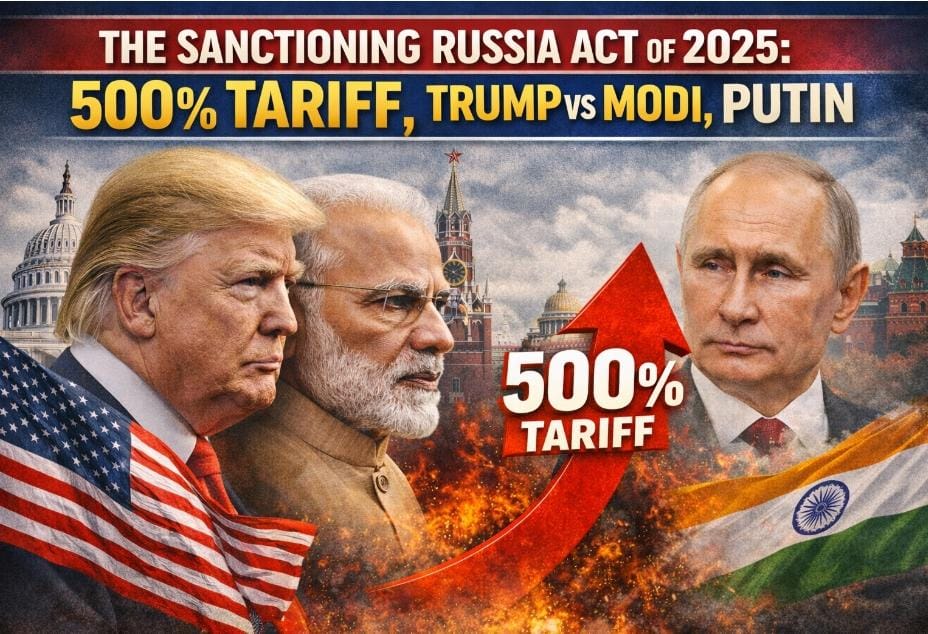
Will India Have to Pay 500% Tariff for Purchasing Russian Oil?
The global trade order is once again facing a potential shock as US President Donald Trump has greenlit a bipartisan sanctions bill that could impose punitive tariffs of up to 500% on countries purchasing Russian oil. India, one of the world’s largest importers of discounted Russian crude, finds itself directly in the spotlight.
The proposed legislation — The Sanctioning Russia Act of 2025 — has been framed by US lawmakers as a tool to choke Moscow’s war finances. However, for countries like India, China, and Brazil, it raises serious questions about energy security, trade sovereignty, and future relations with Washington.
This detailed explainer breaks down what the bill means, whether India will really face a 500% tariff, and how severe the impact could be.
Trump 500% Tariff on India: Why This Bill Matters
US Senator Lindsey Graham, who spearheaded the legislation, stated that President Trump has “greenlit” the bill, calling it a powerful weapon to pressure countries buying Russian oil.
According to Graham, the bill would give Trump “tremendous leverage against countries like China, India, and Brazil” that continue to import discounted Russian energy.
For India, which has already been hit with up to 50% US tariffs on certain exports, the proposed law could mark a new escalation in trade tensions.
What Is The Sanctioning Russia Act of 2025?
Overview of the Proposed Law –
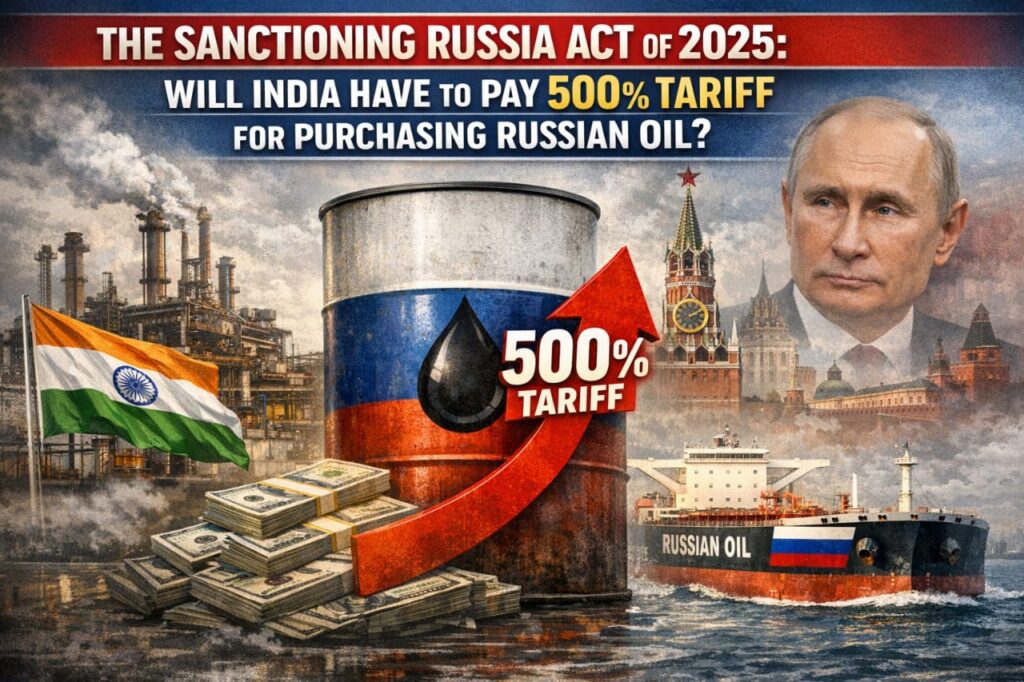
The Sanctioning Russia Act of 2025 is a bipartisan US sanctions framework designed to penalize not just Russia, but countries and entities that do business with Russia’s energy sector.
Key Provisions at a Glance –
| Provision | Details |
|---|---|
| Target | Buyers of Russian oil, gas, uranium |
| Penalty | Secondary tariffs up to 500% |
| Scope | Countries, companies, individuals |
| Focus | Oil resale and secondary trade |
| Authority | Discretionary power to US President |
The bill does not automatically impose tariffs. Instead, it empowers the US President to decide when and on whom the penalties apply.
Will India Really Have to Pay a 500% Tariff?
Short Answer: Not Automatically
Despite alarming headlines, India will not automatically face a 500% tariff if the bill becomes law.
Here’s Why –
- Presidential Discretion
The bill gives the US President the authority — not the obligation — to impose tariffs. - Negotiation Tool, Not Immediate Punishment
Lawmakers describe the bill as leverage rather than a trigger. - Selective Enforcement Likely
Washington may target specific sectors, goods, or transactions instead of blanket tariffs.
However, the risk remains real, especially if diplomatic negotiations fail.
Why India Buys Russian Oil Despite Pressure?
India’s Energy Reality –
India imports over 85% of its crude oil requirements. After Western sanctions cut Russian access to Europe, Moscow offered crude at steep discounts.
Why Russian Oil Became Crucial ?
| Factor | Impact |
|---|---|
| Discounted pricing | Saves billions in forex |
| Stable supply | Insulates India from volatility |
| Refining compatibility | Fits Indian refineries |
| Energy security | Reduces inflation risk |
India’s government maintains that energy purchases are guided by national interest, not geopolitics.
Trump’s Growing Frustration with India:
President Trump has repeatedly expressed dissatisfaction with India’s trade and energy policies.
Trump’s Key Complaints –
- India buying “cheap Russian oil”
- High tariffs on US goods
- Trade imbalance favouring India
Trump has publicly stated that tariffs on India could be raised “very quickly” if oil imports from Russia continue.
India vs China vs Brazil: Who Is Most at Risk?
Comparison of Russian Oil Buyers –
| Country | Russian Oil Dependence | Trade Exposure to US | Risk Level |
|---|---|---|---|
| India | High | High | Very High |
| China | Very High | Moderate | Medium |
| Brazil | Moderate | Low | Lower |
India’s heavy export dependence on the US makes it particularly vulnerable.
Why the World Watches Nicolas Maduro ?
Impact of Trump 500% Tariff on India’s Economy:
Sectors at Greatest Risk –
- Textiles
- Footwear
- Marine products
- Auto components
- Engineering goods
These are labour-intensive industries, meaning The Sanctioning Russia Act of 2025 could impact employment as well.
Estimated Economic Impact (Illustrative Graph) –
Export Loss Risk Index (0–10)
Textiles        ██████████ 9
Footwear        ████████   8
Marine Products ███████    7
Engineering     ██████     6
Pharma          ███        3
Why This Comes at a Bad Time for India ?
India is currently without a bilateral trade deal with the US, unlike:
- EU–US frameworks
- Japan–US agreements
- South Korea–US FTA
A weaker negotiating position could force India to make tougher concessions in future trade talks.
Legal Uncertainty: Will The Sanctioning Russia Act of 2025 Survive US Courts?
The timing of the bill is crucial.
US Supreme Court Factor –
The US Supreme Court is set to rule on whether Trump’s earlier global tariffs exceeded presidential powers under the IEEPA law.
Lower courts have already ruled against the administration.
If the court limits tariff authority, implementation of the 500% tariff may face legal hurdles.
India’s Diplomatic Response So Far:
- India has rejected claims that it promised to stop buying Russian oil.
- Indian diplomats have conveyed that purchases are already reducing gradually.
- Delhi has chosen strategic silence over public confrontation.
India is also accelerating trade diversification.
India’s Plan B: Diversifying Trade & Energy
Trade Agreements Under Negotiation –
| Region | Status |
|---|---|
| European Union | Advanced talks |
| ASEAN | Review phase |
| GCC | Under negotiation |
| Australia | Interim deal signed |
| Canada | On hold |
| Africa (SACU) | Early stage |
Energy Diversification Efforts –
- Increased Middle East imports
- Renewed talks with African producers
- Strategic petroleum reserves expansion
Is This a Bluff or a Real Threat?
Arguments Suggesting Pressure Tactic –
- No automatic enforcement
- Election-year politics
- Diplomatic signalling to Russia
Arguments Suggesting Serious Intent –
- Bipartisan support
- Repeated Trump warnings
- Existing high tariffs on India
Conclusion: It is both leverage and a credible threat.
What Happens Next? Timeline to Watch
| Event | Expected Timeline |
|---|---|
| Congressional vote | Next 1–2 weeks |
| Supreme Court ruling | Imminent |
| US Ambassador assumes charge in India | January 12 |
| India-US trade talks | Q1 2026 |
Frequently Asked Questions (FAQs):
Q1. What is the “The Sanctioning Russia Act of 2025”?
It refers to a proposed US law that allows tariffs of up to 500% on countries buying Russian oil.
Q2. Will India definitely pay 500% tariff?
No. It depends on the US President’s discretion and diplomatic negotiations. More….
Q3. Why is the US targeting Russian oil buyers?
To cut funding for Russia’s war in Ukraine.
Q4. Can India challenge the tariffs legally?
Yes, through WTO and bilateral mechanisms.
Q5. Is India reducing Russian oil imports?
Yes, imports are expected to fall to a three-year low.
Final Verdict: What The Sanctioning Russia Act of 2025 Means for India?
According to The Sanctioning Russia Act of 2025 the Trump 500% tariff on India is not an immediate reality — but it is a serious strategic warning.
India is walking a delicate line between:
- Protecting energy security
- Preserving trade access to the US
- Maintaining strategic autonomy
Whether the tariff is imposed or not, the era of cheap Russian oil without consequences may be coming to an end.
About the Author