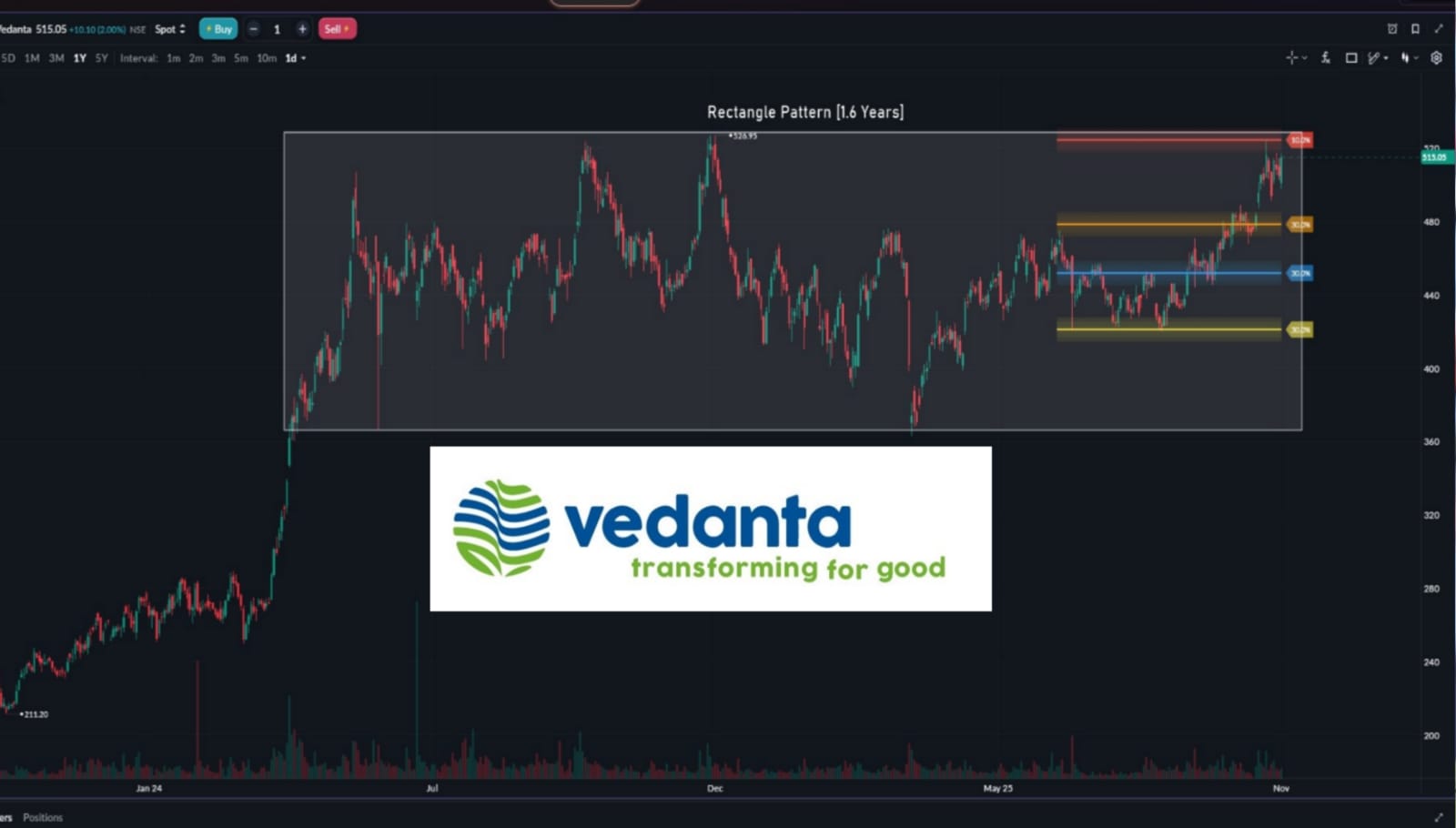
Vedanta Stock Analysis 2025-2026
Vedanta Stock Analysis: Executive Summary
Vedanta Limited (NSE: VEDL) remains one of the most talked-about stocks in India’s metals and mining space as we move into 2026. With the stock trading close to lifetime highs, a landmark six-way demerger underway, and one of the highest dividend yields among large-cap stocks, Vedanta has become a focal point for both income investors and high-risk growth seekers.
This Vedanta stock analysis covers everything investors need to know — company background, financial health, demerger structure, price targets, technical outlook, dividend sustainability, peer comparison, risks, and FAQs.
Vedanta Share Price Performance (2023–2025):
Chart Type: Line Chart
| Year | Share Price (₹) |
|---|---|
| 2023 | 300 |
| 2024 | 420 |
| Jan 2025 | 520 |
| Jun 2025 | 560 |
| Dec 2025 | 601 |
Vedanta shares have more than doubled in two years, driven by:
- Strong commodity prices
- Aggressive dividend payouts
- Final approval of the demerger plan
- Renewed institutional interest
The recent rally has pushed the stock into price discovery mode, making valuation and future outlook critical for investors.
Company Background: Understanding Vedanta Limited
Before we search Vedanta stock analysis we much be know about Vedanta company backgroun. Vedanta Limited is one of India’s largest natural resource conglomerates, founded by Anil Agarwal. Over decades, it has transformed from a metals company into a diversified global player across mining, energy, and future-focused materials.
Key Business Segments
- Zinc, Lead & Silver – Via Hindustan Zinc, the world’s largest integrated zinc producer
- Aluminium – India’s largest aluminium manufacturer
- Oil & Gas – Cairn India assets form a major profit engine
- Iron Ore & Steel – Strong domestic mining presence
- Copper – Important refined copper operations
- Future Businesses – Semiconductors, display glass, nickel, clean energy
This diversification gives Vedanta a natural hedge against commodity cycles, unlike single-commodity peers.
Vedanta stock analysis: Financial Snapshot (December 2025)
Key Financial Metrics Table –
| Metric | Value (Approx.) | Interpretation |
|---|---|---|
| Current Market Price | ₹601 | Near all-time high |
| Market Capitalisation | ₹2.35 Trillion | Large-cap stock |
| P/E Ratio (TTM) | 15.8 | Below sector average |
| Dividend Yield | 5.2% – 7.2% | Among highest in Nifty stocks |
| Debt-to-Equity | 2.12 | High leverage |
| Return on Equity | ~30% | Strong profitability |
| EBITDA Margin | 25–28% | Robust operating efficiency |
| Revenue Growth | 12–15% YoY | Stable expansion |
📌 Verdict: Financials show strong cash generation but elevated leverage remains a key risk.
Debt Analysis: Is Vedanta’s High Debt a Concern?
Vedanta’s debt has always been a double-edged sword.
Key Points –
- High leverage funded expansion and acquisitions
- Debt-to-equity above 2 requires close monitoring
- Parent company (Vedanta Resources) depends on dividends
Why the Demerger Matters for Debt ?
Post-demerger:
- Debt will be distributed across individual entities
- Each business will have clearer balance sheets
- Cash-generating units like Zinc and Oil & Gas will carry manageable leverage
👉 Debt reduction post-demerger is the single biggest trigger for re-rating.
Vedanta Demerger 2026: Complete Breakdown
Structure of the Demerger –
Vedanta will split into six independent listed companies:
- Vedanta Aluminium
- Vedanta Oil & Gas
- Vedanta Base Metals (Zinc, Copper, Lead)
- Vedanta Steel & Iron Ore
- Vedanta Power
- Vedanta Ltd (Holding company for semiconductors & new tech)
Shareholder Entitlement –
👉 For every 1 Vedanta share, investors will receive 1 share in each of the 5 new companies.
Timeline –
- NCLT approval: ✔️ Done
- Expected listing: H1 2026
Why the Demerger Could Unlock Massive Value:
Key Benefits –
- Removal of conglomerate discount
- Sector-specific valuations
- Better capital allocation
- Easier strategic partnerships
- Investors can hold or sell specific businesses
Historically, Indian demergers have unlocked 15–30% value within 12–18 months.
Vedanta stock Technical Analysis:
Key Levels –
- Resistance: ₹612 – ₹620
- Breakout Target: ₹640+
- Immediate Support: ₹585
- Major Support: ₹525
Indicators –
- RSI near 68 (strong momentum, not overheated)
- Price above 50-DMA & 200-DMA
- Volume expansion confirms institutional buying
📊 Short-term consolidation possible, trend remains bullish.
Vedanta Share Price Target 2026:
Brokerage Targets –
| Brokerage | Rating | Target (₹) |
|---|---|---|
| CLSA | Outperform | 610 |
| Citi | Buy | 605 |
| Morgan Stanley | Overweight | 625 |
| JP Morgan | Overweight | 630 |
| Goldman Sachs | Neutral | 580 |
🔹 Consensus Target: ₹615
🔹 Upside: Limited on price alone, attractive when dividends included
Vedanta stock Analysis about Dividend: Why Income Investors Love Vedanta ?
Recent Dividends:
- June 2025: ₹7
- August 2025: ₹16
- Total FY25: ₹23+
Dividend Yield:
➡️ 5% to 7% depending on entry price
Is the Dividend Sustainable?
Positives –
- Strong operating cash flow
- History of high payouts
- Oil & Zinc businesses are cash cows
Risks –
- Commodity price swings
- High debt servicing
- Capex for future businesses
📌 Post-demerger, each company will decide its own dividend policy.
Vedanta Dividend History:
Chart Type: Bar Chart
| Year | Dividend per Share (₹) |
|---|---|
| 2022 | 31.5 |
| 2023 | 29.5 |
| 2024 | 24.5 |
| 2025 | 23.0 |
Vedanta Revenue by Segment (Approx.)
Chart Type: Pie Chart / Stacked Bar
| Segment | Revenue Share (%) |
|---|---|
| Zinc, Lead & Silver | 36% |
| Aluminium | 27% |
| Oil & Gas | 22% |
| Iron Ore & Steel | 9% |
| Power & Others | 6% |
Vedanta Debt-to-Equity Trend:
Chart Type: Line Chart
| Year | Debt-to-Equity |
|---|---|
| 2022 | 2.45 |
| 2023 | 2.30 |
| 2024 | 2.18 |
| 2025 | 2.12 |
Vedanta vs Similar Stocks (Peer Comparison):
Chart Type: Comparative Bar Chart
| Company | Focus | P/E | Dividend Yield |
|---|---|---|---|
| Vedanta | Diversified Metals | 15.8 | 5–7% |
| Hindustan Zinc | Zinc & Silver | 18.4 | ~4.8% |
| Hindalco | Aluminium | 21.5 | ~2% |
| Tata Steel | Steel | 24+ | ~2.8% |
| NMDC | Iron Ore | 14.2 | ~5% |
| NALCO | Aluminium PSU | 19.3 | ~4% |
🔎 Vedanta offers the best mix of yield + diversification, but with higher risk.
Bull vs Bear Case: Vedanta Stock Analysis
Bull Case –
- Demerger value unlocking
- Commodity super-cycle potential
- Semiconductor & EV materials optionality
- High dividend yield
- Government support for mining & manufacturing
Bear Case –
- Global recession risk
- Commodity volatility
- ESG & regulatory challenges
- High leverage
- Execution risk during demerger
Sector Outlook: Metals & Mining in 2026
Positive Drivers –
- India infrastructure spending
- EV & renewable energy demand
- China demand stabilisation
- Supply chain diversification
Headwinds –
- Dollar strength
- Global slowdown fears
- Energy cost volatility
Frequently Asked Questions (Vedanta Stock Analysis):
Q1: Is Vedanta a good stock for long-term investment?
A: Vedanta stock analysis: Vedanta presents a compelling long-term proposition for investors comfortable with commodity cyclicality. The demerger creates pure-play entities with focused growth strategies, while the core business generates substantial cash flows. The high dividend yield provides downside protection, and the semiconductor materials venture offers optionality on India’s tech manufacturing ambitions. However, investors should limit allocation given sector volatility and monitor debt reduction progress.
Q2: When will the Vedanta demerger be completed?
A: As of December 2025, the NCLT has granted final approval. The company expects to complete the listing of all six independent entities by the end of the first half of 2026. The exact timeline will depend on regulatory processes, market conditions, and administrative preparations for separate listings.
Q3: What is the latest dividend declared by Vedanta?
A: The most recent significant dividend was the second interim dividend of ₹16.00 per share declared in August 2025. Combined with the earlier ₹7.00 per share dividend, the total declared for FY2025-26 stands at ₹23.00+ per share. The company typically declares dividends quarterly, subject to board approval and financial performance.
Q4: Why is Vedanta stock rising recently?
A: The December 2025 rally is driven by multiple factors: (1) Final NCLT approval for demerger removing uncertainty, (2) Strong Q3 FY26 results with EBITDA growth exceeding estimates, (3) Government approvals for new oil and gas exploration in Andhra Pradesh, (4) Upward revisions in aluminum and zinc price forecasts for 2026, and (5) Broad market rotation toward value and cyclical stocks.
Q5: How will the demerger affect my existing shares?
A: Existing shareholders will receive one additional share in each of the five new operating companies for every Vedanta share held on the record date. Your total investment value will initially remain similar (subject to market pricing of new entities), but now spread across six different companies. You can choose to hold all, or rebalance based on your view of each sector.
Q6: What is the impact of Vedanta’s debt on investment thesis?
A: The elevated debt level (D/E of 2.12) presents both risk and opportunity. The demerger will allocate debt to respective entities based on asset backing and cash flow generation. While leverage amplifies returns during commodity upcycles, it also increases vulnerability during downturns. Management’s commitment to reducing net debt through operational cash flows remains critical to the investment thesis.
Q7: How does Vedanta compare to global mining peers?
A: Vedanta trades at a discount to global peers like Rio Tinto, BHP, and Glencore on P/E basis (15.83 vs 18-22 for global majors). This discount reflects its higher leverage, conglomerate structure (pre-demerger), and country-specific risks. Post-demerger, the individual entities may command valuations closer to global pure-play peers in their respective segments.
Q8: What are the growth drivers for Vedanta beyond traditional metals?
A: Vedanta is strategically pivoting toward future-focused areas: (1) Semiconductor Materials: Through its display glass venture and potential semiconductor fabrication, (2) Nickel Production: Critical for EV batteries, (3) Aluminum Value-Add: Downstream products for automotive and aerospace, (4) Renewable Energy: Increasing share of renewable power for operations, and (5) Oil & Gas Exploration: New blocks with promising reserves.
Q9. Is Vedanta a good long-term stock?
Vedanta suits investors who can tolerate volatility. Demerger, dividends, and commodity exposure make it attractive but risky.
Q10. Is Vedanta debt a major risk?
Yes, but demerger-led balance sheet restructuring may reduce long-term risk.
Final Verdict: Vedanta Stock Analysis 2025–26
Vedanta stands at a historic inflection point. The demerger could redefine its valuation, while dividends provide immediate returns. However, high leverage and commodity cyclicality mean this is not a low-risk stock.
Who Should Invest?
✔ Aggressive investors
✔ Dividend seekers
✔ Investors comfortable with cycles
Who Should Avoid?
❌ Risk-averse investors
❌ Short-term traders chasing momentum
📌 Overall Rating: Cautiously Optimistic for 2026
Conclusion: Vedanta stock analysis –
Vedanta represents a unique investment proposition at the intersection of traditional commodities and future-facing materials. The ongoing demerger could be the most significant value-unlocking event in the company’s history, potentially addressing the conglomerate discount that has long plagued the stock.
For Aggressive Investors: The combination of high dividend yield, demerger catalyst, and exposure to commodity upcycles makes Vedanta an attractive high-risk, high-reward proposition suitable for 5-10% of a diversified portfolio.
For Conservative Investors: The stock’s volatility and leverage may warrant caution. Consider waiting for post-demerger clarity or investing through systematic investment plans (SIPs) to average entry points.
Final Assessment: With strong technical momentum, reasonable valuations compared to peers, and multiple catalysts ahead, Vedanta merits a “Cautiously Optimistic” rating for 2026. The demerger execution and commodity price trajectory will be the primary determinants of shareholder returns in the coming year.
Disclaimer: This Vedanta stock analysis is for informational and educational purposes only. It does not constitute investment advice, recommendation, or solicitation to buy or sell any securities. Investors should conduct their own research and consult with certified financial advisors before making investment decisions. Past performance does not guarantee future results. The author and publisher assume no responsibility for investment decisions made based on this information. Market conditions change rapidly, and the information presented here reflects Vedanta stock analysis as of December 2025.
Mahindra XUV 7XO Full Details read more:
About the Author