What is On Grid Solar System in India: Cost, Working & Benefits
In an era of rising energy costs and growing environmental consciousness, Indian homeowners and businesses are increasingly looking skyward for a solution. The On Grid Solar Power System, a technological marvel that seamlessly blends self-reliance with grid security, has emerged as the frontrunner in India’s renewable energy revolution. This guide delves deep into what this system is, how it works, and why it might be the smartest investment you make for your property.
The Rising Sun of India’s Energy Landscape –
The Indian government’s ambitious renewable energy targets and supportive policies, like subsidies for residential installations, have made solar power more accessible than ever. Among the various options, the grid-tied or on grid solar system stands out for its practicality and economic benefits. It represents a perfect partnership between individual initiative and national infrastructure, allowing you to become both a consumer and a producer of electricity.
Table of Contents:
India’s Solar Push: Why On Grid Systems Are Dominating Rooftops
India has set an ambitious target of 500 GW of non-fossil fuel capacity by 2030, and rooftop solar plays a major role in achieving it. Government incentives, falling panel prices, and improved grid infrastructure have made solar power accessible to everyday homeowners.
Among all system types, the On Grid Solar Power System has emerged as the most widely adopted because it:
- Requires no batteries
- Has lower upfront costs
- Works seamlessly with existing electricity connections
- Qualifies for net metering benefits
For urban and semi-urban homes with reliable grid access, on-grid solar offers maximum financial return with minimal complexity.
What is an On Grid Solar System? Demystifying the Grid-Tied Solution
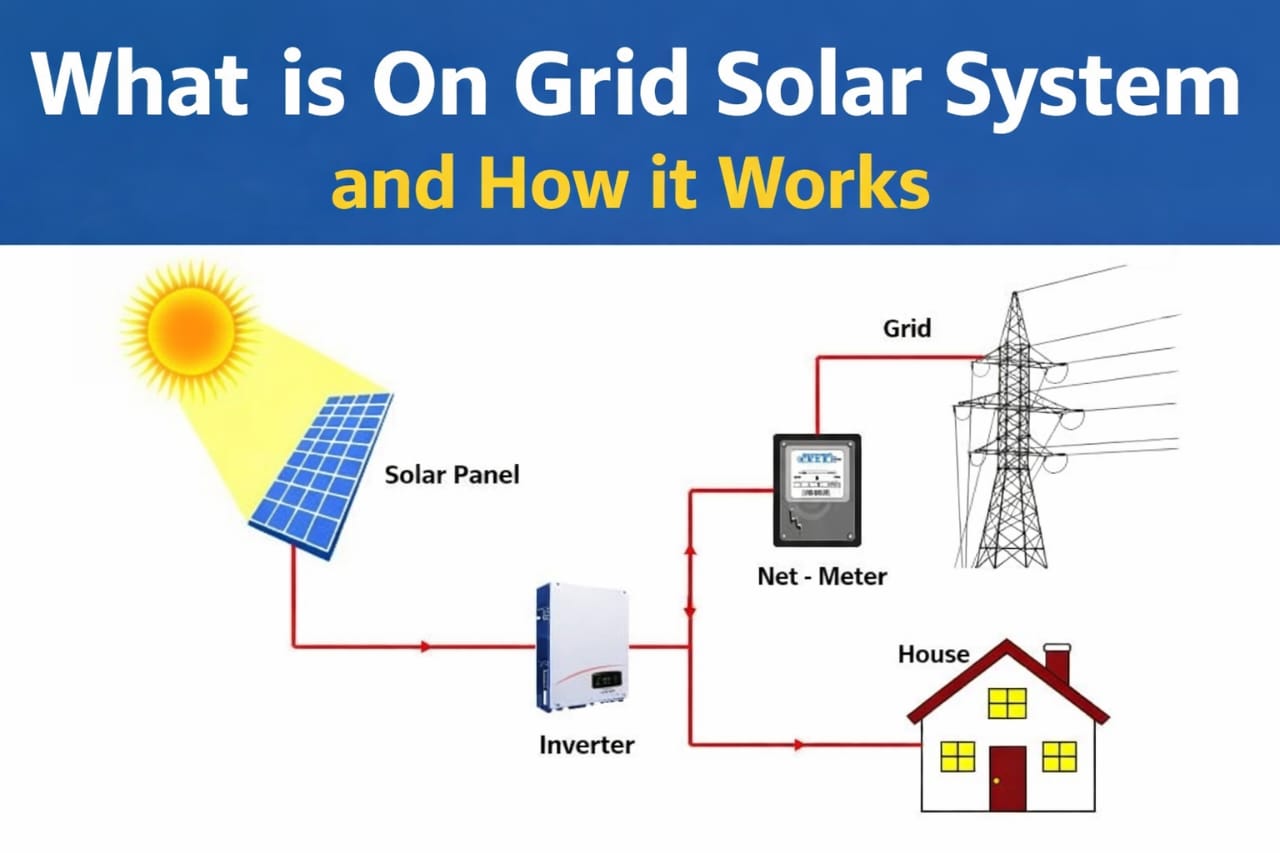
Simply put, an On Grid Solar Power System is a photovoltaic (PV) setup that is directly connected to your local public electricity grid (DISCOM). Think of it as a two-way street for power. During the day, your solar panels generate electricity for your immediate use. Any surplus power isn’t wasted; it’s fed back into the grid. At night or during cloudy weather, when your panels aren’t producing enough, you seamlessly draw power from the grid.
This symbiotic relationship eliminates the need for expensive battery storage, which is a hallmark of off-grid systems. The grid, in effect, acts as a giant, infinite battery, crediting you for the power you supply and providing backup when you need it. This core principle makes understanding what is an on grid solar system crucial for anyone considering the switch to clean energy.
Key Differentiator: On-Grid vs. Off-Grid
| Feature | On-Grid Solar System | Off-Grid Solar System |
|---|---|---|
| Grid Connection | Connected to utility grid | No grid connection; fully independent |
| Battery Storage | Not required (optional backup) | Mandatory for storing energy |
| Power During Outages | No* (shuts off for safety unless hybrid) | Yes, from batteries |
| Excess Energy | Exported to grid for credits (net metering) | Stored in batteries, may be wasted if full |
| Initial Cost | Lower (no battery cost) | Higher (due to batteries) |
| Maintenance | Relatively low | Higher (battery maintenance/replacement) |
| Ideal For | Urban/suburban areas with reliable grid | Remote areas with no or unreliable grid |
*Note: Standard on grid solar systems shut down during a blackout for safety reasons (to prevent feeding electricity into a grid where line workers may be repairing). Systems with battery backup (hybrid) can provide power during outages.
On-Grid vs Off-Grid Solar System Comparison: Which Powers Your Needs Best?
Breaking Down the Components: The Anatomy of an On Grid Solar System
An on grid solar system is a carefully engineered ecosystem. Each component plays a vital role in converting sunlight into usable AC electricity and integrating it with your home and the grid.
- Solar Panels: The most visible component, these are arrays of photovoltaic cells installed on your rooftop or open ground. They capture photons from sunlight and generate Direct Current (DC) electricity. Monocrystalline panels are popular for their high efficiency and space-effectiveness.
- Solar Inverter – The Heart of the System: This is arguably the most critical component. The DC electricity from the panels is not usable by your home appliances. The grid-tie inverter converts this DC into grid-compatible Alternating Current (AC). Modern inverters also perform Maximum Power Point Tracking (MPPT) to optimize energy harvest from the panels under varying weather conditions.
- Mounting Structures: These are the robust, galvanized steel frameworks that securely hold the solar panels in place for 25+ years. Quality structures, like those designed per IS codes and analyzed for wind speeds up to 180 kmph, are essential for long-term safety and performance.
- Bi-Directional Net Meter: This specialized meter, provided by your DISCOM, replaces your old electricity meter. It is the accounting system of your on grid solar system. It records two flows:
- Import: Units of electricity you draw from the grid.
- Export: Units of excess solar electricity you feed back into the grid.
- Balance of System (BoS) – The Unsung Heroes: This includes all the crucial wiring and safety components:
- DC & AC Cables: For connecting panels to the inverter and inverter to the main board.
- AC/DC Combiner Boxes: For safely combining and isolating electrical strings.
- Protection Devices: MC4 connectors, surge protectors, and lightning arresters.
- Earthing Kits: For safety, to divert any fault current into the ground.
How Does an On Grid Solar System Work? A Step-by-Step Journey?
Let’s trace the journey of a sunbeam as it powers your home and benefits your wallet.
- Energy Capture: Sunlight hits the solar panels on your roof, exciting electrons in the silicon cells and generating DC electricity.
- Conversion to Usable Power: This DC electricity travels via cables to the solar inverter. The inverter’s smart electronics convert it into clean, stable 230V AC electricity, synchronized perfectly with the grid’s frequency.
- Powering Your Home: This converted AC power is first supplied directly to your home’s main distribution board. Your running appliances—fans, lights, ACs, refrigerators—instantly and automatically use this solar energy.
- The Net Metering Dance:
- Scenario A (Excess Generation): On a sunny afternoon, if your system produces 10 kWh and your home only uses 4 kWh, the surplus 6 kWh automatically flows back into the grid through the bi-directional meter. The meter records this export.
- Scenario B (Deficit Generation): At night or on a cloudy day, your panels may produce 1 kWh but your home needs 8 kWh. The deficit of 7 kWh is automatically drawn from the grid. The meter records this import.
- Billing Settlement: At the end of the billing cycle, your DISCOM generates a bill based on net consumption.
- Net Units = Imported Units – Exported Units.
- If you exported more than you imported, you receive a credit that rolls over to your next bill, significantly reducing or even zeroing out your payment.
Key Components of an On Grid Solar Power System
Each component plays a critical role in system performance, safety, and durability.
1. Solar Panels – Most Indian homes prefer monocrystalline panels due to their higher efficiency and better performance in limited roof space.
2. Grid-Tie Solar Inverter – Often called the brain of the system, the inverter synchronizes solar power with grid voltage and frequency using MPPT technology.
3. Mounting Structure – Panels are mounted using aluminum or galvanized iron structures designed to withstand wind loads, heat, and monsoon conditions.
4. Bi-Directional Net Meter – Records both exported and imported electricity, enabling net metering credits.
5. Balance of System (BoS) – Includes DC/AC cables, junction boxes, surge protection devices, earthing, and safety isolators.
The Compelling Advantages of Going On-Grid:
The popularity of the on grid solar system is fueled by its tangible benefits:
- Substantial Reduction in Electricity Bills: The primary motivator. By generating your own power, you slash your dependence on grid electricity, leading to savings of 70-90% on your bills. Net metering ensures you get value for every extra unit you produce.
- Attractive Government Subsidy: The Ministry of New and Renewable Energy (MNRE) offers a central financial assistance (CFA) subsidy for residential rooftop systems. This can reduce your upfront cost by ₹30,000 to ₹78,000, depending on system capacity.
- High Return on Investment (ROI): With reduced bills and subsidies, a typical system pays for itself in 4-6 years. Given a system life of 25+ years, you enjoy nearly two decades of virtually free electricity.
- Low Maintenance & Hassle-Free Operation: With no batteries to maintain, the system requires minimal upkeep—occasional panel cleaning and basic system checks are usually sufficient.
- Environmentally Positive: You directly reduce your carbon footprint by displacing fossil-fuel-based grid power with clean, renewable energy.
Cost Analysis: Investing in an On Grid Solar System
The cost of an on grid solar system in India is not fixed; it varies based on location, DISCOM policies, component quality, and installation complexity. Here’s an indicative price table (post-subsidy for residential) to provide a ballpark figure:
| System Capacity | Approximate Area Required | Indicative Price Range (Post-Subsidy, Varies by City & Quality) | Ideal For |
|---|---|---|---|
| 3 kW | 250 – 300 sq. ft. | ₹1,80,000 – ₹2,40,000 | Homes with monthly bills of ~₹2,500-₹4,000 |
| 5 kW | 400 – 500 sq. ft. | ₹2,80,000 – ₹3,60,000 | Larger homes/villas, small offices (bill: ₹5,000-₹8,000) |
| 10 kW | 800 – 1000 sq. ft. | ₹5,50,000 – ₹7,00,000* | Large residences, commercial shops, institutions |
*Subsidy caps apply; commercial systems generally do not attract CFA subsidy.
Factors Influencing Final Cost: Panel type (mono/poly), inverter brand (string/micro), mounting structure height, roof complexity, and after-sales service packages all affect the final quote.
Benefits of an On Grid Solar Power System:
- Major Savings on Electricity Bills: Homes can reduce electricity expenses by 70–90%, depending on system size and usage patterns.
- Government Subsidies: Residential users can avail MNRE subsidies, significantly lowering upfront investment.
- High Return on Investment: Most systems recover costs within 4–6 years, while panels last 25+ years.
- Low Maintenance: Without batteries, maintenance needs are minimal — mostly periodic cleaning.
- Environmentally Responsible: A typical 3 kW system can offset 3–4 tons of CO₂ emissions annually.
Factors That Influence Final Solar Cost:
- Panel efficiency and brand
- Inverter capacity and warranty
- Roof height and mounting complexity
- State-specific DISCOM regulations
- Quality of installation and after-sales service
Net Metering Explained: How You Earn from Solar
Net metering allows your electricity meter to run both forward and backward.
- Excess solar power exported earns energy credits
- Imported electricity at night is adjusted against those credits
- You pay only for the “net” units consumed
This policy is one of the biggest reasons the On Grid Solar Power System remains the most financially attractive option in India.
FAQs: Your On Grid Solar System Questions Answered
Q1: What happens during a power cut in an on grid solar system?
A: For safety, a standard grid-tie inverter automatically shuts off during a blackout. This prevents it from sending power to the grid and endangering line workers. To have backup during outages, you need a hybrid solar system with a battery.
Q2: Is my roof suitable for solar panels?
A: Most south-facing roofs with minimal shading are ideal. East and west-facing roofs also work well. Structural integrity is assessed by installers before proceeding.
Q3: How long does the installation process take?
A: After the site survey and agreement, the process (including net meter application to DISCOM) typically takes 4 to 8 weeks.
Q4: Can I increase my system capacity later?
A: It is possible but can be complex and may require re-approval from your DISCOM and upgrading your inverter. It’s best to plan for future needs during initial installation.
Q5: Do I need to take special insurance?
A: It is highly recommended. You can often add the solar system as a rider to your existing home insurance or take a separate policy to cover against damage from natural calamities.
Why Understanding “What Is an On Grid Solar system” Matters Today?
Knowing what is an on grid solar is no longer optional — it’s essential for anyone planning long-term energy savings. With rising tariffs and increasing power demand, grid-connected solar offers predictable costs and energy security without operational complexity.
The Future is Bright and Grid-Tied
Choosing an on grid solar system is a decision that marries economic pragmatism with ecological responsibility. It represents a proactive step towards energy independence while remaining securely tethered to the collective safety net of the grid. With government incentives lowering the entry barrier and technology ensuring high efficiency, there has never been a better time to understand what is an on grid solar system and become a part of India’s clean energy future.
By investing in sunlight, you’re not just locking in your energy costs for the next quarter-century; you’re contributing to a greener, more sustainable grid for everyone. Consult with a certified and reputable solar provider to get a personalized assessment and embark on your journey from an electricity bill payer to a modern-day prosumer.
Conclusion:
Investing in an On Grid Solar Power System is not just about saving money — it’s about future-proofing your energy needs while contributing to a cleaner planet.
If you’ve ever wondered what is an on grid solar and whether it’s right for you, the answer for most Indian homes and businesses in 2026 is a confident yes.
🌞 The sun is ready. The grid is ready. Are you?
About the Author